垌
Character Story & Explanation
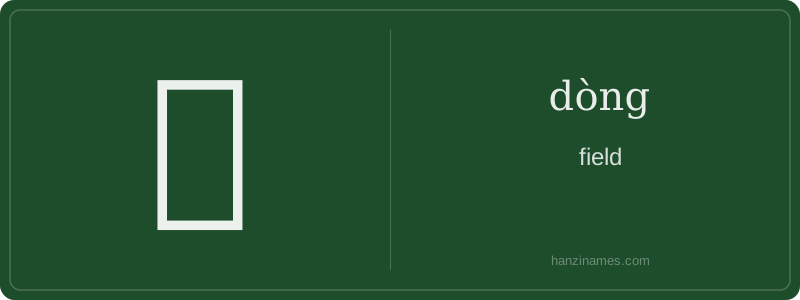
垌 is predominantly used in southern Chinese toponyms and rural speech—not in standard Mandarin textbooks or HSK lists, but in real geographical names like 'Shilong Dong' (石龙垌) in Guangdong or 'Dongcun' (垌村) villages across Guangxi. It appears in local land registries, village histories, and agricultural extension documents as a unit of cultivated land measurement, often equivalent to ~0.5–1 mu (333–667 m²). No major idioms feature it, reflecting its regional, functional role rather than literary abstraction.
The character is not ancient—it does not appear in oracle bone or bronze inscriptions. Its earliest verified usage is in Ming- and Qing-dynasty local gazetteers from Lingnan. Graphically, it combines 土 (earth) and 同 (same), likely phonetic-semantic: 同 provides the sound (dòng resembles tóng in some dialects), while 土 specifies meaning—'earth of shared use'. Today, farmers in western Guangdong still say '去垌里干活' ('go work in the dong') when heading to specific plots outside village perimeters.
At first glance, 垌 (dòng) appears simple—a field, a plot of land. Yet in Chinese agrarian cosmology, it embodies quiet sovereignty: not wilderness nor wilderness tamed, but land deliberately named, claimed, and tended. Its radical 土 (earth) anchors it in material reality, while the right-side component 同 (tóng, 'same') subtly suggests communal belonging—fields shared, boundaries acknowledged, harvests measured not just in grain but in kinship.
This character reflects a worldview where geography is relational, not abstract. A 垌 isn’t merely coordinates on a map; it’s the unit of ancestral memory—where grandparents planted rice, where village rituals begin, where land deeds and lineage records converge. Unlike generic terms like 田 (tián, 'field') or 地 (dì, 'ground'), 垌 carries regional weight: it names land as *known*, *named*, and *inhabited*—a microcosm of harmony between human labor and earth’s rhythm.
In southern China—especially Guangdong, Guangxi, and parts of Fujian—the word 垌 persists in place names and oral land discourse, resisting homogenization by modern administrative language. It signals continuity: when elders point to ‘the old 垌 behind the pond’, they invoke layered time—ecological knowledge, family history, and quiet resistance to erasure. Thus, 垌 is more than vocabulary; it’s a lexical vessel for rootedness in an age of displacement.
Example Sentences
Common Compounds
Similar Characters — Don't Mix These Up
Your First Step into Chinese Culture: Get a Chinese Name
Every journey into Chinese begins with a name. Use our free Chinese name generator to create a meaningful, personalized Chinese name that fits you perfectly.
Get My Chinese Name →