垏
Character Story & Explanation
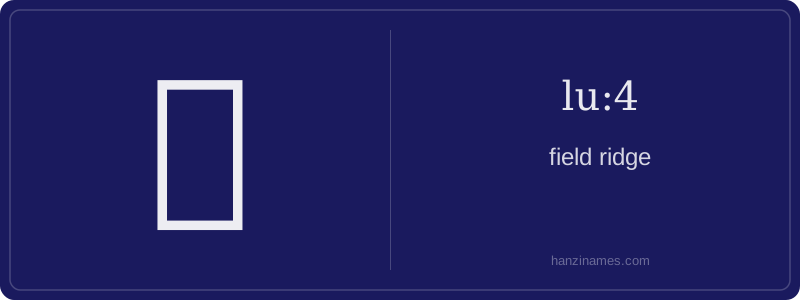
垏 is rarely used in daily Mandarin conversation today but remains active in agricultural administration, land registry records, and regional dialects — especially in North China. It appears in official documents like the ‘Rural Land Contract Law’ (《农村土地承包法》) when defining plot demarcations. Though absent from common idioms, it surfaces in local expressions such as ‘垎垈垏堰’ (hè dǎi lù yàn), a historical term for micro-landform features in Shandong farmland, documented in Qing-era land surveys.
The character is a semantic-phonetic compound: the left radical 土 (tǔ, ‘earth’) indicates meaning, while the right component 吕 (lǚ) serves phonetically — though pronunciation shifted from *lǚ* to *lù* over time. No oracle-bone or bronze script forms survive; it first appears in Song dynasty lexicographic works like the *Jiyun* (1037 CE) as a specialized term for cultivated field boundaries.
The character 垏 (lù) embodies a quiet, grounded aspect of traditional Chinese agrarian life — the earthen ridge that separates fields. Unlike grand philosophical or poetic characters, 垏 reflects practical wisdom: boundaries that organize labor, conserve water, prevent soil erosion, and mark communal land use. Its very existence signals harmony between human intention and natural topography — not domination over land, but collaboration with it.
In classical Chinese worldview, land is never abstract; it is relational, layered with memory, labor, and lineage. The 垏 is both functional and symbolic: a low physical barrier that carries legal, ecological, and social weight. Village elders once settled disputes over field boundaries by walking the 垏 — its height, width, and vegetation were evidence of long-standing usage, making it a silent witness to intergenerational stewardship.
This character reveals how Chinese thought embeds ethics in infrastructure. A ridge isn’t just dirt piled high — it’s shared responsibility made visible. In modern China, while mechanized farming has flattened many traditional 垏, the term persists in land surveys, rural policy documents, and dialect speech across Henan, Shandong, and Shanxi. Its endurance shows how deeply culture is rooted — not in monuments, but in the earth between rows of wheat.
Example Sentences
Common Compounds
Similar Characters — Don't Mix These Up
Your First Step into Chinese Culture: Get a Chinese Name
Every journey into Chinese begins with a name. Use our free Chinese name generator to create a meaningful, personalized Chinese name that fits you perfectly.
Get My Chinese Name →