垓
Character Story & Explanation
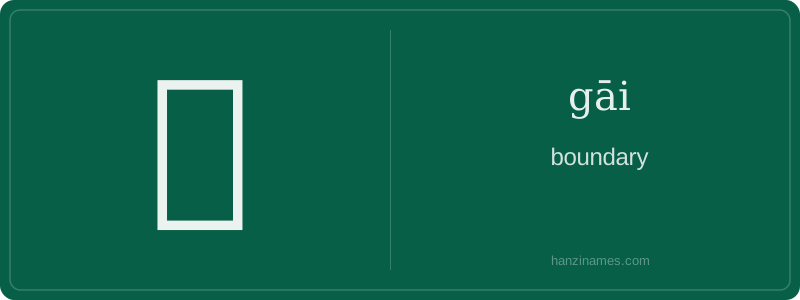
垓 is virtually unused in modern spoken Chinese and absent from HSK lists (HSK Level: Not included). Its primary documented use is historical and literary: most famously in the idiom 四面楚歌 (sìmiàn chǔgē, 'surrounded on all sides') referring to Xiang Yu’s last stand at 垓下 (Gāixià) in 202 BCE—a place name meaning 'below the boundary ridge.' It survives exclusively in classical texts, historical place names, and mathematical contexts as a large-number unit (10²⁰).
The character’s form is not pictographic but phono-semantic: 土 (tǔ, 'earth') is the semantic radical indicating terrain-related meaning, while 亥 (hài, the 12th Earthly Branch) provides phonetic approximation. No oracle bone or bronze script forms exist—its earliest attestation is in Warring States bamboo manuscripts, confirming its origin as a late Zhou administrative term for surveyed land limits.
As an archaeologist brushing dust from a Han dynasty bamboo slip, I find 垜 inscribed not as a common word—but as a precise geomantic marker. Its 土 (earth) radical anchors it in land surveying, while the 亥 component—originally a celestial stem denoting the twelfth lunar phase—suggests cyclical boundary reckoning. This was no abstract line: it marked imperial territorial limits, military encampment perimeters, and ritual precincts where heaven, earth, and human order converged.
Excavations at Mawangdui revealed 垓 used in administrative documents to delimit tax zones and granary storage sectors. Unlike generic terms like 界 (jiè), 垓 implied *constrained, sanctioned space*—a boundary enforced by law and cosmology. The nine-stroke structure reflects its function: three horizontal strokes (earth layers), two verticals (boundary markers), and four angular turns (the cardinal directions anchoring the perimeter).
Its rarity today isn’t decline—it’s specialization preserved. In Tang steles, 垓 appears in temple boundary stones; in Song land registers, it quantifies ‘one square li of bounded farmland.’ Even now, when scholars reconstruct ancient city walls or interpret Ming cadastral maps, 垓 remains the technical term for a *ritually sanctioned, administratively fixed boundary*—not just where land ends, but where authority begins.
Example Sentences
Common Compounds
Similar Characters — Don't Mix These Up
Your First Step into Chinese Culture: Get a Chinese Name
Every journey into Chinese begins with a name. Use our free Chinese name generator to create a meaningful, personalized Chinese name that fits you perfectly.
Get My Chinese Name →