垔
Character Story & Explanation
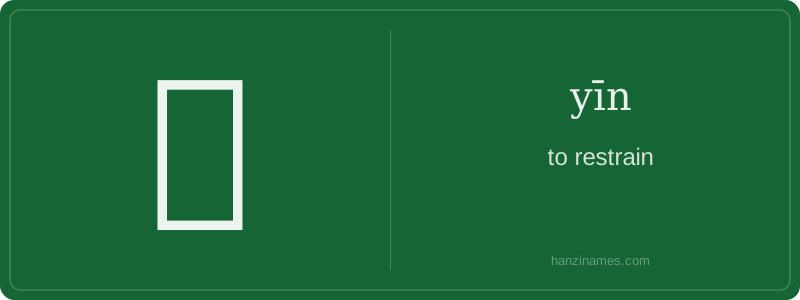
垔 is virtually absent from modern spoken and written Mandarin. It appears only in historical lexicographic sources (e.g., the Kangxi Dictionary) and classical texts describing flood management, such as references to Yu the Great’s water-control efforts. No contemporary idioms or common phrases use 垔; it has been functionally replaced by characters like 堵 (dǔ, 'to block') or 拦 (lán, 'to intercept').
The character is documented as a phono-semantic compound: 土 (earth, semantic) + 西 (xī, phonetic, though pronunciation shifted to yīn). Its earliest attested form appears in seal script (c. 3rd century BCE), showing stacked earth layers—consistent with its meaning of 'piling earth to restrain water.' Today, Chinese learners encounter it only in advanced classical Chinese courses or paleography studies.
The Chinese character 垔 (yīn) is a rare, archaic character meaning 'to restrain' or 'to dam up'—originally referring to controlling water flow by piling earth. Its structure combines the 'earth' radical (土) with a phonetic component (西), reflecting its ancient association with hydraulic engineering and flood control in early agrarian China.
Unlike common modern verbs for 'restrain' like 控制 (kòngzhì) or 限制 (xiànzhì), 垔 appears almost exclusively in classical texts and historical compound words. It carries a sense of physical, material containment—earth blocking water—not abstract regulation. This concrete, elemental connotation distinguishes it from Western notions of restraint rooted in law, ethics, or psychology.
In cross-cultural comparison, 垔 aligns less with English 'restraint' (a noun implying self-control or moderation) and more with technical terms like 'embankment' or 'levee'—structures that physically impede natural forces. It evokes ancient Chinese statecraft: the ruler as hydrologist, maintaining order by mastering nature’s chaos—a worldview where governance and geomorphology were inseparable.
Example Sentences
Common Compounds
Similar Characters — Don't Mix These Up
Your First Step into Chinese Culture: Get a Chinese Name
Every journey into Chinese begins with a name. Use our free Chinese name generator to create a meaningful, personalized Chinese name that fits you perfectly.
Get My Chinese Name →