垛
Character Story & Explanation
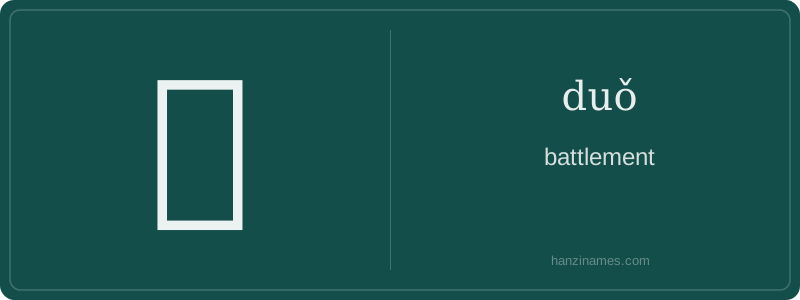
In contemporary China, 垛 appears primarily in heritage conservation, military history texts, and architectural documentation—especially concerning the Great Wall and Ming-era city walls. The phrase 马面垛口 (mǎmiàn duǒkǒu), meaning 'horse-face battlement', refers to the projecting towers with staggered 垛口 that enabled flanking fire—a documented Ming defensive innovation verified in archaeological surveys and the 14th-century *Huolongjing* (Fire Dragon Manual). It also appears in agricultural contexts: in northern Shaanxi and Shanxi, farmers still use duò (duò) to mean ‘stacked hay or grain pile’, a usage recorded in Qing-dynasty local gazetteers.
The character is not pictographic but phono-semantic: 土 (tǔ) signals meaning related to earth/construction; 又 (yòu) historically served as a phonetic hint (though pronunciation diverged over time). Its earliest attested form appears in Han dynasty clerical script, already bearing the modern structure—no oracle bone or bronze inscriptions survive for this character.
Imagine standing atop the ancient Ming Dynasty wall in Xi’an at dawn—the mist curls around weathered stone, and your hand brushes against a rhythmic series of raised, rectangular protrusions along the parapet. These are 垛 (duǒ): defensive battlements—solid, spaced, and purpose-built for archers to shelter behind while firing. Each one is a silent testament to centuries of military engineering, not merely decoration but functional architecture shaped by necessity and precision.
The character 垛 itself mirrors this structure: its 土 (earth/soil) radical grounds it in construction and material reality, while the 又 (again) component hints at repetition—just as battlements appear in measured sequence along city walls. Though pronounced duǒ in modern standard Mandarin, the alternate reading duò survives in regional dialects and historical texts, especially when referring to stacked grain piles—a semantic bridge between defense and agrarian life.
Today, 垛 appears most often in historical descriptions, architectural terminology, and literary metaphors evoking steadfastness or layered protection. It’s rarely used in casual speech but remains vivid in place names like 垛口 (duǒkǒu)—‘battlement opening’—and in conservation reports about China’s Great Wall sections. Its visual simplicity (9 strokes) belies deep cultural weight: a single character that anchors us to both battlefield strategy and the quiet rhythm of walled cities.
Example Sentences
Common Compounds
Similar Characters — Don't Mix These Up
Your First Step into Chinese Culture: Get a Chinese Name
Every journey into Chinese begins with a name. Use our free Chinese name generator to create a meaningful, personalized Chinese name that fits you perfectly.
Get My Chinese Name →