垝
Character Story & Explanation
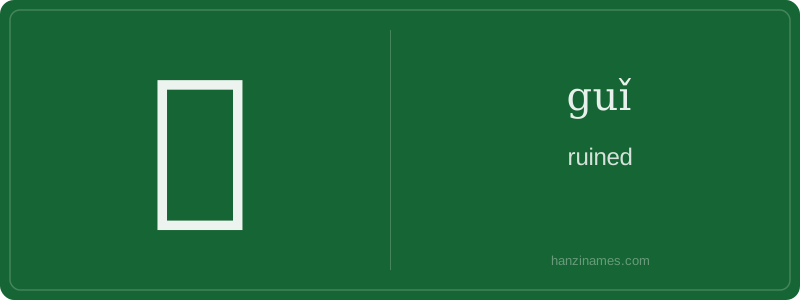
垝 appears most famously in the Shijing (Book of Odes), specifically in Ode 243, ‘Gǔfēng’ (‘The Old Wind’): ‘乘彼垝垣,以望复关’ — ‘I climbed the ruined wall to gaze toward Fuguan.’ Here, 垝垣 (guǐ yuán) means ‘crumbling wall’, symbolizing longing and isolation. This phrase is widely quoted in Chinese literary education and calligraphy practice. Modern usage is almost exclusively literary or rhetorical—e.g., in essays on heritage preservation or historical novels.
The character’s structure combines 土 (tǔ, ‘earth/soil’) on the left and 危 (wēi, ‘precarious/dangerous’) on the right—a clear semantic-phonetic compound. 危 provides both sound (wēi → guǐ is a historical phonetic shift) and meaning (danger, instability), while 土 indicates material context (earthen walls). No oracle bone or bronze script forms survive, but its seal script form (c. 3rd c. BCE) already shows this composition.
Hello, learners! Today we’re exploring 垝 (guǐ), a character you won’t see often in daily conversation—but it’s rich in literary and historical flavor. It means 'dilapidated', 'collapsed', or 'damaged', especially describing old walls, towers, or structures fallen into ruin. Though rare in modern speech, it appears in classical poetry and historical texts, evoking imagery of abandonment and time’s passage. Think of it as the poetic cousin of more common words like 损坏 (sǔnhuài, 'damaged')—more vivid, more atmospheric.
This character carries strong visual and emotional weight. Its meaning isn’t just physical decay—it often implies loss, nostalgia, or the quiet melancholy of forgotten places. In ancient China, city walls were vital for defense; when a wall was 垝, it signaled vulnerability, decline, or even political instability. That layered resonance is why poets like those in the Shijing (Book of Odes) used it deliberately—not for utility, but for tone and symbolism.
As a beginner, don’t worry about memorizing 垝 for everyday chats—it’s not in HSK levels 1–6. But understanding it helps you appreciate classical Chinese literature and recognize stylistic depth in formal writing. Its rarity makes it a ‘treasure word’: small in usage, big in meaning. When you encounter it, pause—you’re reading something crafted with care, where every character paints a mood. Let’s learn how it lives in real language, not just dictionaries.
Example Sentences
Common Compounds
Similar Characters — Don't Mix These Up
Your First Step into Chinese Culture: Get a Chinese Name
Every journey into Chinese begins with a name. Use our free Chinese name generator to create a meaningful, personalized Chinese name that fits you perfectly.
Get My Chinese Name →