零
Character Story & Explanation
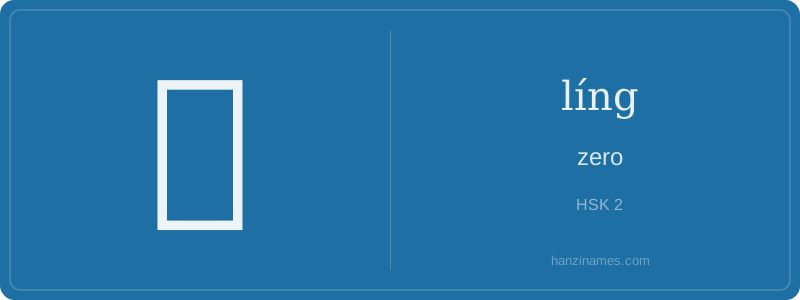
零 entered Chinese mathematics during the Tang and Song dynasties (7th–13th centuries) as a placeholder in positional notation, borrowed from Indian numerals via Buddhist texts. Today, it’s indispensable: used in digital interfaces (e.g., '00:00'), weather reports ('零上/零下'), and common terms like 零售 (retail) and 零食 (snacks). The idiom 零敲碎打 (líng qiāo suì dǎ) — literally 'tapping零碎ly' — means 'to work in bits and pieces', reflecting its core sense of fragmentation.
The character isn’t pictographic like 日 (sun) or 木 (tree). Its form evolved from seal script where the rain radical (雨) combined with 令 (a phonetic component). Historically, 零 described scattered raindrops — hence 'not whole', leading to 'zero' and 'spare'. Modern usage focuses on numerical and distributive functions, not weather imagery.
Hi students! The character 零 (líng) means 'zero' — the number 0. It’s an HSK Level 2 character, so it’s essential for everyday counting, telling time, prices, and math. Though it looks complex with 13 strokes, notice its top part is the ‘rain’ radical (雨), which hints at its original meaning: 'drops falling separately' — a poetic way to express 'scattered, nothing, or emptiness', later adopted for the numerical concept of zero.
Don’t confuse 零 with other numbers like 一 (yī) or 〇 (the circle zero used *only* in numeric contexts like years). 零 is the standard written form in formal and spoken Chinese — you’ll hear it in phrases like ‘零下五度’ (five degrees below zero) or ‘零花钱’ (pocket money). It also carries meanings like ‘fragmentary’ or ‘spare’, showing how language evolves from concrete to abstract.
When writing 零, remember stroke order matters! Start with the rain radical on top (8 strokes), then the lower part (令 — líng, meaning 'command'), which gives both sound and meaning. This is a phono-semantic compound: 雨 hints at the idea of 'dispersion/emptiness', and 令 provides pronunciation. Practice slowly — writing it correctly builds muscle memory and helps avoid mixing it up with similar characters like 霖 or 露.
Example Sentences
Common Compounds
Similar Characters — Don't Mix These Up
Your First Step into Chinese Culture: Get a Chinese Name
Every journey into Chinese begins with a name. Use our free Chinese name generator to create a meaningful, personalized Chinese name that fits you perfectly.
Get My Chinese Name →