非
Character Story & Explanation
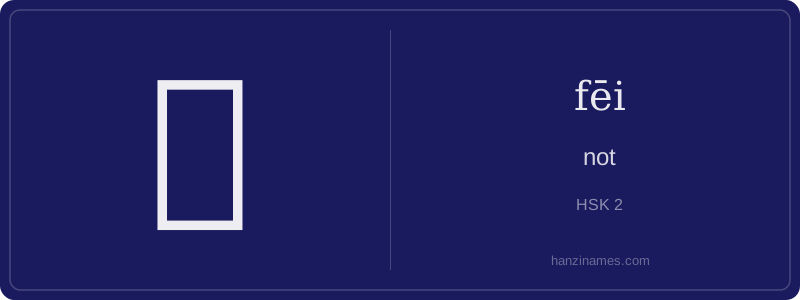
非 is ubiquitous in modern Standard Chinese for formal or emphatic negation — especially in written contexts, official documents, and set phrases. It appears in over 20 HSK-2+ vocabulary items, including common compounds like 非常 (fēicháng, 'very') and 非法 (fēifǎ, 'illegal'). Historically, 非 appears in pre-Qin texts like the *Analects* (e.g., '非礼勿视' — 'Do not look at what is not in accordance with ritual'), establishing its role in Confucian moral reasoning.
The character’s form is not pictographic but ideographic: it evolved from oracle bone script depicting two opposing wings or feathers — symbolizing 'contradiction' or 'separation'. By the Zhou dynasty, it standardized into its current symmetric shape, representing mutual exclusion — two things that cannot coexist. This visual duality directly informs its semantic core: 'not being' something by virtue of being its opposite.
Imagine walking through Beijing’s bustling Panjiayuan Antique Market, where a vendor holds up a weathered Qing-dynasty inkstone and declares, '这不是真品!' (Zhè bú shì zhēn pǐn!) — 'This is not genuine!' The character 非 (fēi) pulses at the heart of that denial. It’s not just grammatical negation — it’s cultural precision. In Chinese, 非 doesn’t merely mean 'not'; it carries weighty contrast, often implying moral or categorical exclusion, like distinguishing authentic heritage from imitation.
At a Shanghai high school, students debate climate policy in Mandarin class. One says, '发展经济非等于牺牲环境' (Fāzhǎn jīngjì fēi děngyú xīshēng huánjìng) — 'Developing the economy does *not equal* sacrificing the environment.' Here, 非 functions as a formal, emphatic negation of equivalence — stronger than 没 (méi) or 不 (bù) alone. Its eight-stroke symmetrical structure mirrors this balanced yet firm rejection.
Even in digital life, 非 appears constantly: on WeChat red envelope warnings ('非本人请勿领取'), government health notices ('非绿码禁止入内'), and university syllabi ('非选修课'). Its presence signals boundaries — legal, ethical, or procedural. Unlike casual negation, 非 introduces principled distinction. That’s why it’s HSK Level 2: learners encounter it early not just to say 'no', but to draw lines with linguistic authority.
Example Sentences
Common Compounds
Similar Characters — Don't Mix These Up
Your First Step into Chinese Culture: Get a Chinese Name
Every journey into Chinese begins with a name. Use our free Chinese name generator to create a meaningful, personalized Chinese name that fits you perfectly.
Get My Chinese Name →