垞
Character Story & Explanation
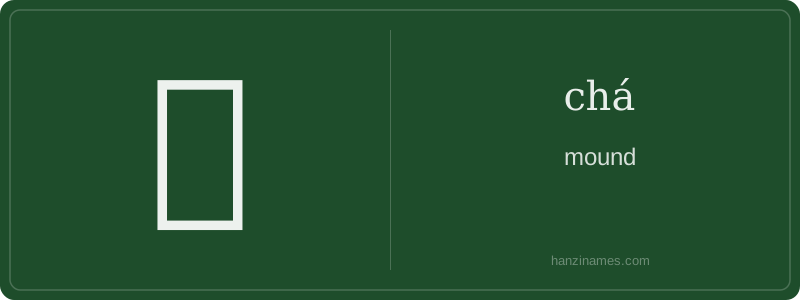
垞 is almost exclusively used in modern Chinese as part of place names—especially in villages and townships across the North China Plain. For example, 'Liujia Cha' (刘家垞) appears in official civil affairs records of Henan Province, and 'Xigou Cha' (西沟垞) is documented in Shandong’s 2020 Rural Administrative Division Catalogue. It rarely occurs outside toponyms and never in idioms, literature, or daily conversation. Linguists classify it as a 'dialectal topolect character' preserved in local governance documents rather than colloquial speech.
The character 垞 is a phono-semantic compound: the left radical 土 (tǔ, 'earth') signals meaning, while the right component 茶 (chá, 'tea') serves as a phonetic loan—though pronounced identically, there's no semantic link to tea. This is a documented case of 'phonetic borrowing' (假借) in later-character formation, not an ancient pictograph. No oracle bone or bronze script forms exist; the earliest attestation is in Qing-dynasty local gazetteers.
The Chinese character 垞 (chá) is a rare, regionally used term meaning 'mound' or 'small earthen hill'—typically referring to a natural or man-made raised landform in rural or historical geographical contexts. Unlike common synonyms like 坡 (pō, 'slope') or 丘 (qiū, 'hill'), 垞 carries a distinctly local flavor, appearing mostly in place names across northern and central China, especially in Henan, Shandong, and Hebei provinces. Its usage reflects how Chinese topography terminology often preserves dialectal and historical layers not captured in standard dictionaries.
Though absent from the HSK syllabus and modern textbooks, 垞 remains functionally alive in toponymy and local administrative records. It does not appear in classical literary texts as a standalone semantic unit but surfaces in Ming- and Qing-dynasty gazetteers describing village terrain. Its rarity underscores how Mandarin standardization has marginalized many regional geomorphological terms—even as they persist on maps, land deeds, and oral speech among older rural residents.
In cross-cultural comparison, 垞 aligns most closely with English 'mound' (e.g., burial mound, spoil heap) or German 'Hügel', but differs from broader Western landscape terms like 'knoll' (which implies gentleness) or 'barrow' (archaeologically specific). Unlike the mythic resonance of English 'cairn' or Japanese 'tsuka' (塚), 垞 lacks ritual or poetic connotation—it’s purely descriptive, pragmatic, and geographically grounded, reflecting traditional Chinese agrarian attention to subtle land variation for farming and flood management.
Example Sentences
Common Compounds
Similar Characters — Don't Mix These Up
Your First Step into Chinese Culture: Get a Chinese Name
Every journey into Chinese begins with a name. Use our free Chinese name generator to create a meaningful, personalized Chinese name that fits you perfectly.
Get My Chinese Name →