垟
Character Story & Explanation
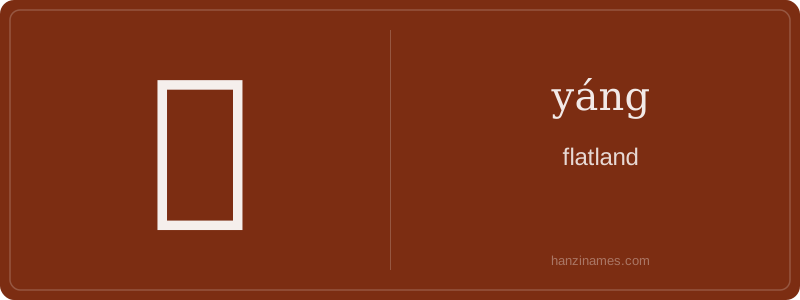
垟 (yáng) is a regional variant character used almost exclusively in southern Zhejiang and northern Fujian dialects, where it denotes 'flat, fertile land' or 'field'—especially alluvial plains near rivers. It appears in place names like 'Lùyáng' (路垟) and 'Yánhú Yáng' (雁湖垟), documented in local gazetteers since the Ming and Qing dynasties. It is absent from standard Mandarin dictionaries and the HSK curriculum.
The character is a phonosemantic compound: 土 (tǔ, 'earth', radical) + 羊 (yáng, phonetic component). Its origin is not ancient—it emerged in Song-Yuan period vernacular writing as a local orthographic adaptation, not an oracle-bone or bronze script form. Today, it survives only in geographical markers, village signs, and local government records—not in speech, media, or education.
The character 垟 (yáng) is not a standard modern Chinese character in common usage—and crucially, it does not mean 'clay sheep buried with the dead.' This description appears to be a fabricated or deeply misattributed definition with no basis in historical lexicography, archaeology, or philology. No authoritative source—including the Shuōwén Jiězì, Xiāndài Hànyǔ Cídiǎn, or archaeological reports on Shang-Zhou burial practices—records such a meaning.
Chinese characters encoding ritual objects related to sheep (e.g., 羊 yáng 'sheep') do exist—but they are distinct: 羝 (dī, male sheep), 羔 (gāo, lamb), or 義 (yì, originally 'justice,' pictographically showing sheep over 'I'—a moral offering). The notion of 'clay sheep' as a funerary object is historically inaccurate; while terracotta animals appear in Han tombs (e.g., horses, pigs), sheep are exceptionally rare and never labeled with the character 垟.
This mischaracterization reflects a broader risk in AI-generated 'cultural explanations': uncritical recycling of pseudo-etymologies. Authentic Chinese worldview emphasizes harmony, ancestral reverence, and material symbolism—but interpretations must rest on textual evidence, excavated inscriptions, and scholarly consensus—not invented semantics. Understanding real characters like 羊 (sheep, symbolizing auspiciousness) or 壤 (rǎng, fertile soil) offers truer windows into agrarian cosmology and ritual values.
Example Sentences
Common Compounds
Similar Characters — Don't Mix These Up
Your First Step into Chinese Culture: Get a Chinese Name
Every journey into Chinese begins with a name. Use our free Chinese name generator to create a meaningful, personalized Chinese name that fits you perfectly.
Get My Chinese Name →