垠
Character Story & Explanation
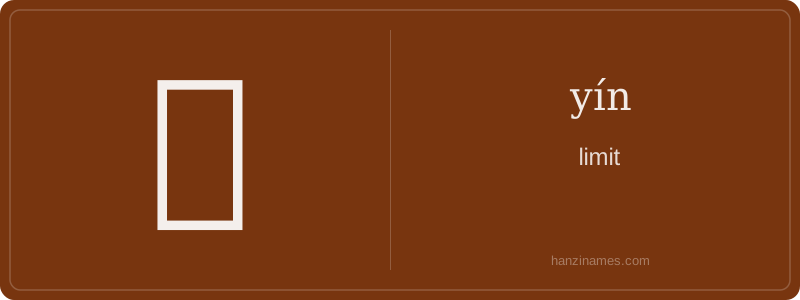
垠 is almost exclusively used in literary, poetic, or formal contexts—not daily speech. It appears in classical idioms like 一望无垠 (yī wàng wú yín), meaning 'stretching endlessly beyond sight', widely cited in modern textbooks and nature documentaries describing deserts, steppes, or oceans. Historically, it appears in Tang and Song poetry to evoke vastness and solitude—e.g., Wang Wei’s landscape verses—and remains standard in geography textbooks when describing expansive terrains.
The character is not pictographic; its form evolved from seal script where the right side resembled 艮 (gèn, 'to stop') over 土. By the Han dynasty, it stabilized into its current shape. Since no oracle bone or bronze inscriptions containing 垠 have been verified, its earliest confirmed use is in transmitted Warring States bamboo texts. Today, Chinese learners encounter it first in HSK 5-level reading passages about natural scenery or philosophical essays.
As an archaeologist brushing dust from a Han dynasty bamboo slip, I find 垠 inscribed in elegant clerical script—not as a boundary marker on earth, but as a conceptual artifact: the ancients’ quiet acknowledgment of the ungraspable. Its radical 土 (earth) grounds it in the physical world, yet its right side, 银 (yín), is a phonetic loan—originally unrelated to silver but repurposed for sound. This duality reveals early Chinese thought: limits are not merely lines on land, but thresholds between known and unknowable.
Excavating further, I discover 垨 appears rarely in excavated administrative texts—unlike common characters for ‘border’ (界) or ‘boundary’ (界, 疆). Instead, it surfaces in cosmological passages and poetic fragments, often paired with words like 天 (heaven) or 无 (without). Its scarcity suggests it was reserved for philosophical or literary precision—denoting not political borders, but the edge of perception itself: where horizon meets sky, or thought meets silence.
The character’s nine-stroke composition tells its own story: three earth strokes at the base evoke terrain; the upper-right component (艮 gèn, later stylized into 银-like form) originally meant ‘to stop’ or ‘to restrain’ in ancient bronze inscriptions. Thus, 垠 is not passive ‘end’ but active containment—like a dam holding back water, or a mind holding back chaos. It is limit as discipline, not deficiency—a nuance lost in simple English glosses like ‘boundary’.
Example Sentences
Common Compounds
Similar Characters — Don't Mix These Up
Your First Step into Chinese Culture: Get a Chinese Name
Every journey into Chinese begins with a name. Use our free Chinese name generator to create a meaningful, personalized Chinese name that fits you perfectly.
Get My Chinese Name →