垮
Character Story & Explanation
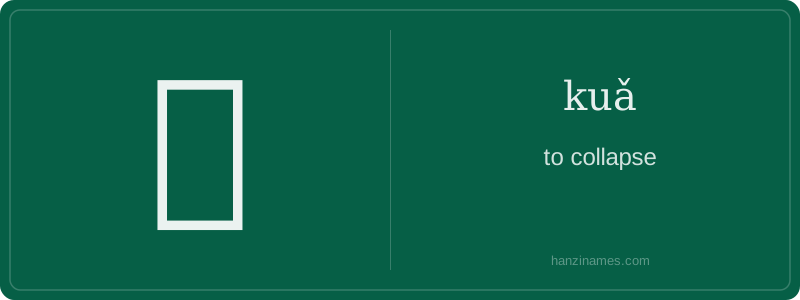
垮 is widely used in modern Chinese media and policy discourse — especially in phrases like 经济垮了 (jīngjì kuǎ le, 'the economy has collapsed') or 搞垮 (gǎo kuǎ, 'to sabotage/ruin'), frequently appearing in official statements about financial risk control and anti-corruption campaigns since the 2010s. It also appears in well-known idioms such as 垮台 (kuǎ tái, 'to fall from power'), historically used in mid-20th-century political commentary. While not ancient, its usage surged post-1980s in economic reform discussions.
The character’s form is not pictographic but phono-semantic: the left side 土 (tǔ, 'earth') is the semantic component, indicating relation to physical structure or stability; the right side 跨 (kuà, 'to stride') originally served as a phonetic hint — though pronunciation diverged over time. No oracle bone or bronze script forms exist for 垮; it emerged later, likely during the Han dynasty or after, as a derivative character for abstract collapse.
Hi students! Let’s learn 垮 (kuǎ), a vivid verb meaning 'to collapse' — not just physically, like a wall falling down, but also figuratively, like a business failing or someone’s health deteriorating. It’s a strong, dramatic word — you won’t use it for small setbacks. Notice the radical 土 (tǔ), meaning 'earth' or 'soil', which hints at something grounded giving way — think of soil eroding or a foundation crumbling. This character appears in serious contexts: news reports, literature, and formal speech.
Grammatically, 垮 is usually used as a resultative complement after verbs (e.g., 搞垮 — 'to ruin completely') or as a standalone verb in past or potential aspect (e.g., 垮了 — 'has collapsed'). It rarely stands alone without context — you’ll almost always see it paired with another verb or modified by degree words like 彻底 (thoroughly) or 突然 (suddenly). Its tone is kuǎ — third tone, dipping then rising — so practice saying it with clear contour: kǔǎ → kuǎ.
This character is not in the HSK 1–6 official lists, meaning it’s considered *beyond* standard proficiency — often encountered in advanced reading, journalism, or historical texts. But don’t be intimidated! Mastering 垮 helps you understand nuanced expressions of failure, decline, or breakdown in Chinese society — from infrastructure to emotions. As you progress, you’ll notice how precisely Chinese uses different ‘collapse’ verbs: 倒 (dǎo) for sudden toppling, 跨 (kuà) for striding — but only 垮 carries that sense of irreversible, systemic failure.
Example Sentences
Common Compounds
Similar Characters — Don't Mix These Up
Your First Step into Chinese Culture: Get a Chinese Name
Every journey into Chinese begins with a name. Use our free Chinese name generator to create a meaningful, personalized Chinese name that fits you perfectly.
Get My Chinese Name →