垺
Character Story & Explanation
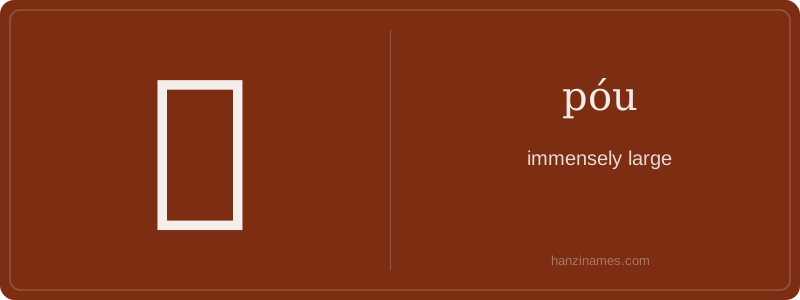
垺 is virtually absent from modern spoken Chinese and does not appear in any HSK level (HSK 1–9). It occurs only in classical literature, historical glossaries, and epigraphic sources—most notably in the Shuōwén Jiězì (c. 121 CE), where Xu Shen defines it as 'very large' (甚大也) and classifies it under the 土 (earth/soil) radical. No idioms or set phrases containing 垺 are listed in authoritative modern dictionaries (e.g., Xiàndài Hànyǔ Cídiǎn), confirming its fossilized status.
The character’s form combines 土 (tǔ, 'earth') and 否 (fǒu, originally meaning 'not' or 'obstruction', later phonetic). Its structure reflects Han dynasty phonosemantic composition—not a pictograph, but a logical derivation: 'earth so vast it defies limits.' Today, it appears only in scholarly editions, calligraphy demonstrations of rare characters, or as a trivia question in national Chinese language competitions.
The character 垺 (póu) is a rare, classical Chinese word meaning 'extremely large' or 'vast beyond measure.' Though nearly obsolete in modern spoken Mandarin, it survives in literary texts, historical inscriptions, and poetic diction—often evoking grandeur, cosmic scale, or ancient geography. Its usage conveys weight and antiquity, like invoking the immensity of mountains or the boundlessness of heaven in Tang dynasty poetry.
Unlike common synonyms such as 大 (dà) or 巨 (jù), 垺 carries a distinctly archaic, almost mythic resonance. It appears in classical compound terms like 垺垺 (póu póu), where reduplication intensifies the sense of overwhelming magnitude. This linguistic rarity makes it a prized find for advanced learners and sinologists studying pre-Qin or Han textual fragments.
Despite its obscurity today, 垺 remains culturally significant—not as a functional vocabulary item, but as a lexical artifact revealing how early Chinese conceptualized scale and transcendence. Its presence in excavated bamboo manuscripts (e.g., the Shanghai Museum Warring States texts) confirms its authentic historical usage, not merely dictionary invention. Understanding 垺 deepens appreciation for the semantic richness embedded in China’s written heritage.
Example Sentences
Common Compounds
Similar Characters — Don't Mix These Up
Your First Step into Chinese Culture: Get a Chinese Name
Every journey into Chinese begins with a name. Use our free Chinese name generator to create a meaningful, personalized Chinese name that fits you perfectly.
Get My Chinese Name →