垾
Character Story & Explanation
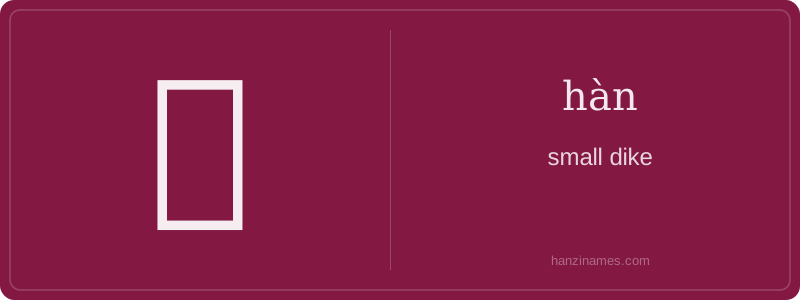
垾 appears primarily in historical and regional agricultural documentation—not daily conversation. It’s documented in Ming and Qing dynasty water management texts, such as the Jiangnan Shuili Quanshu (Comprehensive Water Conservancy of Jiangnan), where it denotes field-level dikes separating paddy plots. No idioms or set phrases feature 垾; it’s too narrow in scope. Modern usage is nearly extinct except in archival research, local place names (e.g., 垾头村 in Jiangsu), and academic studies of traditional Chinese agriculture.
The character is not pictographic—it evolved as a phono-semantic compound. Its earliest attestation is in Song-era lexicographical works like the Jiyun (1037 CE), where it’s defined explicitly as ‘small dike’ (小隄). There’s no oracle bone or bronze script form; it emerged later as a practical, written solution for land management terminology.
Our detective begins at the scene: the character 垾 (hàn), a rare but precise term for 'small dike'—a low earthen embankment built to control water flow in rice paddies or irrigation channels. Unlike common water-related characters like 河 (river) or 湖 (lake), 垾 is hyper-localized, appearing almost exclusively in agricultural and hydrological contexts, especially in historical land records and regional dialects of Jiangsu, Zhejiang, and Anhui.
Zooming in on its structure, 垾 combines the soil radical 土 (tǔ) on the left—signaling material composition—and the phonetic component 干 (gān/hàn), which here contributes pronunciation rather than meaning. Though 干 usually means 'dry' or 'to do', its ancient variant forms once carried alternate readings, allowing it to serve as a reliable phonetic clue for hàn in this compound.
Forensic analysis of dictionaries confirms that 垾 is not found in classical Confucian texts or poetry—it’s a technical, functional character born from agrarian necessity. Its absence from modern HSK lists and general literacy tests reflects its specialized status: not a word you’d learn in Mandarin class, but one you’d encounter on a village land survey, in a local gazetteer, or while reading Ming-Qing dynasty hydraulic engineering reports.
Example Sentences
Common Compounds
Similar Characters — Don't Mix These Up
Your First Step into Chinese Culture: Get a Chinese Name
Every journey into Chinese begins with a name. Use our free Chinese name generator to create a meaningful, personalized Chinese name that fits you perfectly.
Get My Chinese Name →