垿
Character Story & Explanation
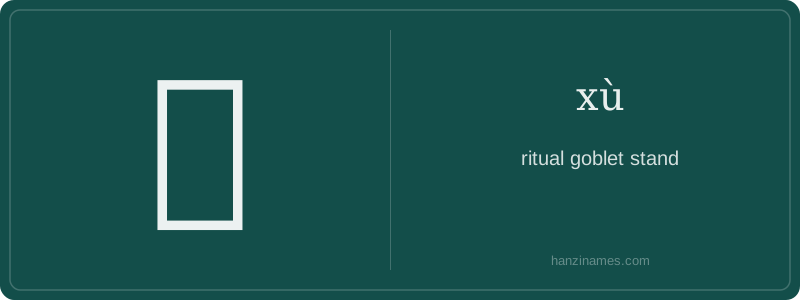
垿 is virtually unused in modern spoken or written Mandarin outside academic sinology, classical text editing, or ritual reconstruction projects. It appears exclusively in pre-Qin and Han commentaries on the *Book of Rites* (*Liji*) and *Zuo Zhuan*, always paired with 反坫. No idioms, slang, or contemporary compounds contain it; it has no presence in HSK lists, dictionaries for learners, or digital input methods beyond Unicode support. Its survival is purely textual and scholarly.
The character is a late-formed phonosemantic compound (ca. Warring States period), with 土 (earth) as semantic indicator and 序 (xù) as phonetic. No oracle bone or bronze script forms exist—its earliest attestation is in transmitted Warring States bamboo manuscripts (e.g., *Shanghai Museum Bamboo Slips*, vol. III). It was never a pictograph; it was engineered for precision in ritual discourse.
As an archaeologist brushing dust from a Zhou dynasty bronze inscription, I first encountered 垿 not as a living character—but as a ghost in the textual record: a rare, almost spectral term preserved only in classical ritual texts. It denotes a specific earthen platform (反坫, fǎndiàn) used in ancient Chinese aristocratic wine ceremonies, where guests would ritually return their ceremonial goblets. Its absence from oracle bone or bronze inscriptions suggests it emerged later—likely during the Eastern Zhou—as a technical term in Confucian ritual codification.
This character is a linguistic artifact, not a pictograph but a phonosemantic compound: the ‘earth’ radical (土) signals material and function, while the phonetic component 序 (xù, ‘order, sequence’) hints at its role in the choreographed etiquette of ancestral rites. Unlike common characters, 垿 carries no colloquial baggage—it exists solely to anchor a vanished material practice: the precise spatial grammar of Zhou hospitality, where even the placement of a wine stand signaled moral reciprocity and hierarchical balance.
Modern excavations at Luoyang’s Eastern Zhou royal precincts have unearthed low, rectangular rammed-earth platforms matching textual descriptions of 反坫—confirming that 垿 was not metaphorical but architectural. Its rarity today reflects the collapse of that ritual ecosystem: when Confucius lamented ‘the decline of ritual’, he was mourning structures like this—both physical and lexical. To study 垿 is to hold a shard of Zhou cosmology: earth shaped into meaning, silence made legible through script.
Example Sentences
Common Compounds
Similar Characters — Don't Mix These Up
Your First Step into Chinese Culture: Get a Chinese Name
Every journey into Chinese begins with a name. Use our free Chinese name generator to create a meaningful, personalized Chinese name that fits you perfectly.
Get My Chinese Name →