埂
Character Story & Explanation
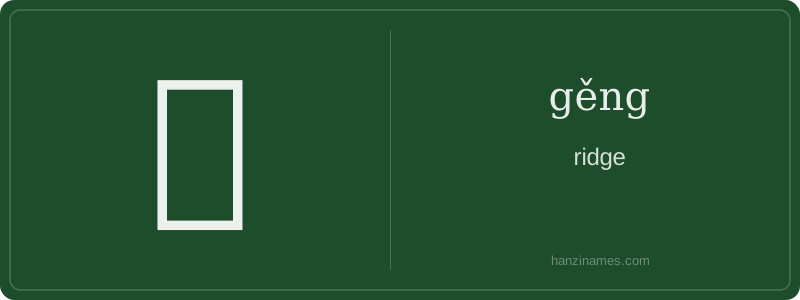
埂 is commonly used in agricultural contexts across China—especially in rice-growing provinces like Hunan, Jiangxi, and Guangdong—to denote earthen ridges between paddy fields. It appears in official documents from the Ministry of Agriculture and Rural Affairs (e.g., 2021 ‘Rural Land Management Guidelines’) and in field-level training pamphlets for cooperative farming. While no major idioms feature 埂, it occurs in fixed phrases like ‘田埂’ (tián gěng, ‘field ridge’) and ‘河埂’ (hé gěng, ‘riverbank ridge’), both documented in the 《现代汉语词典》 (7th ed., 2016).
The character is not pictographic in origin—it evolved from seal script forms where the ‘土’ radical anchored its meaning, while ‘更’ served phonetically (gēng). No oracle bone or bronze inscriptions contain 埂; it first appears reliably in Song-dynasty agricultural texts. Today, Chinese farmers in Shaoxing still point to a tián gěng to direct workers: ‘Walk along the gěng—not in the water!’
Imagine walking through the emerald rice paddies of Zhejiang’s Jiangnan region at dawn—the air damp and fragrant with wet earth. Between flooded fields rise narrow, raised earthen ridges: firm, sun-baked, just wide enough for a farmer to stride along. These are 埂 (gěng)—not walls, not roads, but humble, functional strips of high ground that separate plots, control water flow, and anchor irrigation. They’re quiet infrastructure, shaped by generations of hands tamping soil into resilience.
埂 is deeply practical, rooted in agrarian life. Its 土 (earth) radical signals its material essence—formed from compacted soil—and the right side ‘更’ (gēng) hints at function: originally linked to ‘change’ or ‘adjustment’, reflecting how these ridges regulate water levels during planting and flooding cycles. Unlike decorative embankments, 埂 is low-profile, utilitarian, and often unmarked on maps—yet vital to small-scale farming across southern China.
In daily speech, 埂 carries a gentle, grounded connotation—evoking stability, boundary, and quiet stewardship of land. It appears in regional dialects more frequently than in formal Mandarin, especially among older farmers who still refer to field edges by name rather than GPS coordinates. Though absent from HSK lists (indicating limited use in standardized curricula), it remains linguistically alive in rural signage, agricultural extension materials, and local place names like ‘Liujia Geng’ (Liu Family Ridge) in Jiangsu province.
Example Sentences
Common Compounds
Similar Characters — Don't Mix These Up
Your First Step into Chinese Culture: Get a Chinese Name
Every journey into Chinese begins with a name. Use our free Chinese name generator to create a meaningful, personalized Chinese name that fits you perfectly.
Get My Chinese Name →