多
Character Story & Explanation
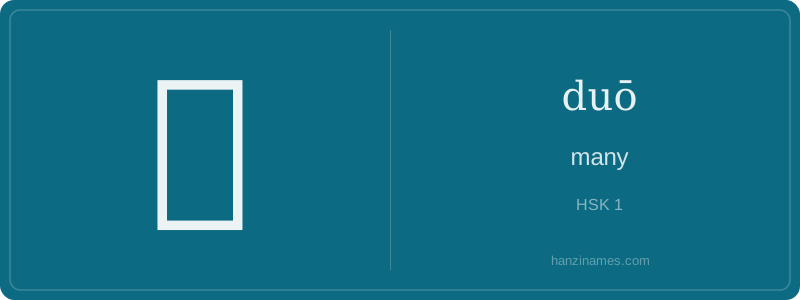
多 has been a core quantifier in Chinese for over two millennia, appearing in classical texts like the Analects (e.g., ‘多闻阙疑’ — ‘be widely informed but withhold judgment on doubts’). Today, it’s indispensable in daily speech: from shopping (‘这个多少钱?’ — How much is this?) to expressing excess (‘太多了!’ — Too much!). It’s central in the common phrase 多少 (duōshǎo), meaning ‘how many/much’, used in over 90% of beginner-level quantity questions.
The character 多 is a phono-semantic compound with debated origins, but its earliest verified form (in bronze inscriptions, c. 1000 BCE) shows two ‘sun-at-dusk’ symbols (夕), suggesting repetition or plurality — a logical visual metaphor for ‘more than one’. Modern usage prioritizes its function over pictorial origin, making it a perfect anchor for learning Chinese quantification.
Hello, learners! The character 多 (duō) is one of the most essential and frequently used words in Chinese — it’s your go-to word for expressing quantity. At HSK Level 1, it appears early because it’s simple to write (just 6 strokes), easy to pronounce (duō, with a high, flat first tone), and incredibly versatile. You’ll see it everywhere: in questions like ‘How many?’ (多少?), in comparisons (more than), and even in emotional expressions like ‘too much!’ (太多啦!). Mastering 多 opens the door to describing abundance, degree, and frequency.
Visually, 多 is made of two 夕 (xī) radicals stacked — originally representing ‘evening’ or ‘sunset’, but here used phonetically and repetitively to suggest ‘more than one’. Though it looks symmetrical, remember: the top 夕 is slightly smaller and higher, and the bottom one sits lower with a longer bottom stroke. Writing it correctly helps avoid confusion with similar characters like 夕 or 夜. Practice writing it slowly while saying ‘duō’ aloud — this builds muscle memory and tone accuracy together.
Grammatically, 多 is flexible: it can modify nouns (many books), verbs (much more careful), or serve as a question word (how much/many?). It never stands alone as a full sentence — it always needs context, like a noun or measure word. For example, you say ‘很多书’ (hěn duō shū — many books), not just ‘多书’. Also, note that 多 is rarely used without a modifier like 很 (very) or 有 (there is) before it in affirmative statements — a subtle but crucial pattern beginners should internalize early.
Example Sentences
Common Compounds
Similar Characters — Don't Mix These Up
Your First Step into Chinese Culture: Get a Chinese Name
Every journey into Chinese begins with a name. Use our free Chinese name generator to create a meaningful, personalized Chinese name that fits you perfectly.
Get My Chinese Name →