学
Character Story & Explanation
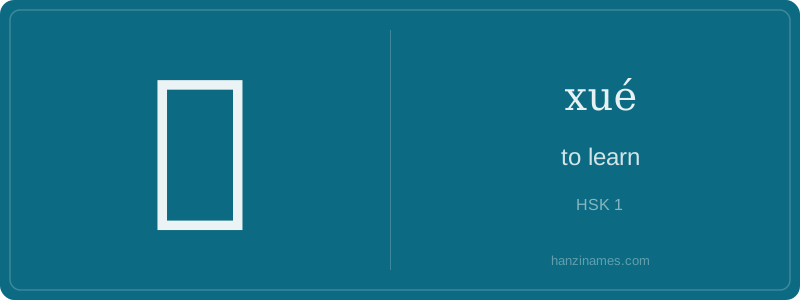
学 appears ubiquitously in modern China: on school gates (学校), university diplomas (学位证), and national campaigns like 'Xuexi Qiangguo' (Study the Nation app, launched 2019, now used by over 200 million people). It’s central in idioms like 活到老,学到老 (‘Live until old, learn until old’) — a proverb widely cited by educators and leaders since the Ming dynasty.
The character evolved from seal script (c. 3rd century BCE), where it combined 子 (child) with a phonetic component 覚 (jué, archaic for ‘awaken’ or ‘realize’). Though not a pictograph, its structure reflects early recognition that learning requires both youthful receptivity (子) and conscious awakening (the upper part, later simplified to ⺍). No oracle bone form survives — its earliest attested use is in bronze inscriptions of the Warring States period.
The character 学 (xué) embodies the Confucian ideal that learning is not passive absorption but lifelong, self-cultivating action. In classical Chinese thought, ‘to learn’ means to internalize wisdom through reflection, practice, and moral growth — not merely acquiring facts. This reflects a worldview where knowledge and virtue are inseparable, and education serves both personal refinement and social harmony.
Unlike Western notions that often separate learning from being, 学 integrates cognition with conduct: one ‘learns’ by observing elders, emulating sages, and embodying principles in daily life. The radical 子 (child) at its base signals that learning begins humbly — as a student, always open, never finished. This humility before knowledge remains central to Chinese pedagogy and scholarly tradition.
Even today, 学 carries ethical weight beyond academics: to ‘learn filial piety’ (学孝) or ‘learn diligence’ (学勤) implies embodied practice, not theoretical study. Its presence in words like 学校 (school), 学问 (scholarship), and 学者 (scholar) reveals how deeply learning is woven into identity, duty, and social contribution — making 学 less a verb and more a lifelong vocation.
Example Sentences
Common Compounds
Similar Characters — Don't Mix These Up
Your First Step into Chinese Culture: Get a Chinese Name
Every journey into Chinese begins with a name. Use our free Chinese name generator to create a meaningful, personalized Chinese name that fits you perfectly.
Get My Chinese Name →