十
Character Story & Explanation
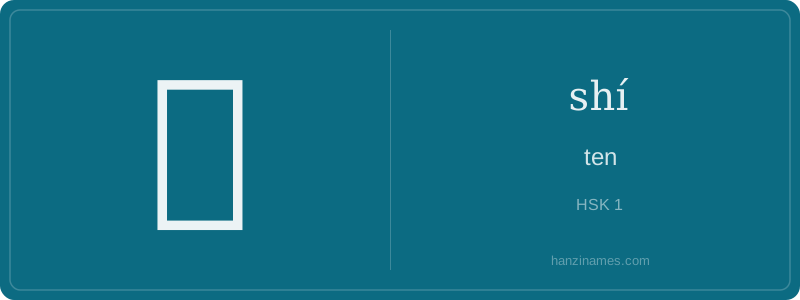
十 is indispensable in daily Chinese: it appears in time (十点 *shí diǎn* '10 o’clock'), age (十岁 *shí suì* 'ten years old'), prices (十元 *shí yuán* '10 yuan'), and mathematics. It anchors idioms like 十全十美 (*shí quán shí měi*, 'perfect in every way') and historical terms like 十月革命 (*Shíyuè Gémìng*, 'October Revolution'). During the Cultural Revolution, the 'Ten Great Relationships' (十大关系) shaped economic policy—documented in Mao’s 1956 speech.
The character originated as a pictograph of a knot or cross-tally—verified by oracle bone inscriptions (e.g., Heji 36508). Unlike disputed glyphs, 十’s form shows zero variation across earliest sources: two straight strokes crossing at center. No animal, object, or landscape inspired it—only the human act of marking 'one group of ten'.
As a detective tracing 十, I begin at the Shāng dynasty oracle bones (c. 1200 BCE), where this character appears as a simple, unadorned cross—two perpendicular strokes intersecting near their centers. Unlike later stylized forms, early inscriptions show remarkable consistency: no hooks, no curves—just clarity and balance. This wasn’t an abstract symbol born of philosophy, but a pragmatic tally mark, likely evolving from counting notches or grouped strokes. Its minimalism reflects ancient numeracy’s need for speed and legibility in divination records and inventory tallies.
By the Western Zhōu bronze inscriptions, 十 gained subtle refinement: the vertical stroke often extends slightly below the horizontal, and both lines thicken toward the ends—a sign of brush-and-ink influence even before true calligraphy emerged. Yet its core identity remains untouched. Crucially, it never merged with other numerals; unlike ‘five’ (五) or ‘seven’ (七), which acquired phonetic or semantic complications, 十 stayed pure—functionally isolated, semantically stable, and graphically unambiguous across three millennia.
Modern standardization cemented what tradition preserved: a two-stroke radical that doubles as an independent character and a foundational component in dozens of compound characters (e.g., 南 *nán* 'south', 博 *bó* 'abundant'). Its stroke order—vertical first, then horizontal—is codified in the GB 13000.1 standard and taught uniformly in mainland China, Taiwan, and Singapore. Even in digital fonts, the glyph preserves the centered intersection—proof that utility, not ornament, guided its evolution.
Example Sentences
Common Compounds
Similar Characters — Don't Mix These Up
Your First Step into Chinese Culture: Get a Chinese Name
Every journey into Chinese begins with a name. Use our free Chinese name generator to create a meaningful, personalized Chinese name that fits you perfectly.
Get My Chinese Name →