三
Character Story & Explanation
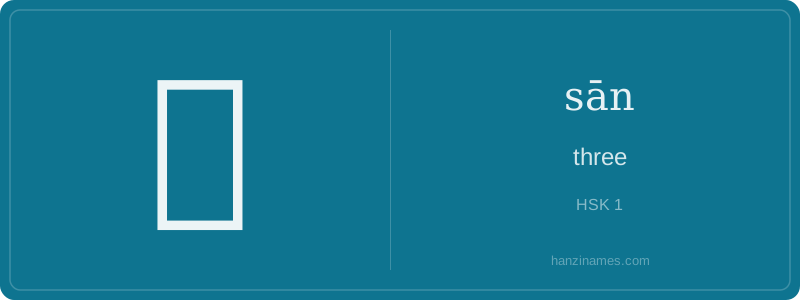
三 is ubiquitous in daily Chinese: from bus route numbers (e.g., 公交3路, Gōngjiāo Sān Lù) to street names (三里屯, Sānlǐtún), and common phrases like 三天 (sān tiān, 'three days') or 三思 (sān sī, 'think thrice' — from Confucius’s Analects 5.20). It appears in idioms like 举一反三 (jǔ yī fǎn sān, 'from one example infer three'), emphasizing deep understanding. Historically, oracle bone inscriptions (c. 1200 BCE) show 三 as three parallel lines — a clear, unambiguous pictograph of quantity, making it one of the earliest attested numerals in Chinese writing.
The character’s form has remained remarkably stable for over 3,000 years — three horizontal strokes representing countable units. Unlike more complex characters, its origin isn’t debated: it’s a direct visual tally, reflecting ancient counting practices before abstract numerals existed.
Welcome to your first journey into Chinese characters! The character 三 (sān) means 'three' — simple, foundational, and one of the very first numbers you’ll learn. It’s an HSK Level 1 character, so it’s essential for beginners. With only three horizontal strokes, it’s also one of the easiest to write — but don’t underestimate its importance! In Chinese, numbers are used constantly: for counting, telling time, giving ages, and even expressing ideas like balance and harmony.
Notice how each stroke is a straight, even line — no curves or hooks. The top stroke is shortest, the middle slightly longer, and the bottom longest (though in modern standard script, they’re often drawn nearly equal). This subtle variation reflects traditional calligraphic aesthetics. As a radical itself (一), 三 builds meaning through repetition — three lines symbolizing multiplicity, completeness, and stability.
Unlike English, where ‘three’ is just a word, 三 carries cultural weight: it appears in classical philosophy (e.g., the ‘Three Treasures’ of Daoism), traditional medicine (‘three burners’), and everyday expressions like ‘three times’ meaning ‘repeatedly’. Pronouncing it correctly matters too — sān uses the first tone (high and flat), so practice saying it like singing a steady note: “SĀN!”
Example Sentences
Common Compounds
Similar Characters — Don't Mix These Up
Your First Step into Chinese Culture: Get a Chinese Name
Every journey into Chinese begins with a name. Use our free Chinese name generator to create a meaningful, personalized Chinese name that fits you perfectly.
Get My Chinese Name →