发
Character Story & Explanation
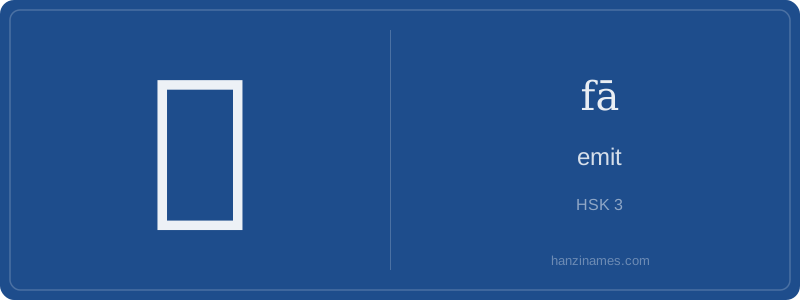
发 is ubiquitous in modern Mandarin: used daily in phrases like fā yóujiàn (send email), fā xīn wén (issue news), and fā zhǎn (develop). It appears in the national slogan ‘gòngtóng fāzhǎn’ (shared development) and key HSK-3 vocabulary like fāmíng (invention) and fāyán (to speak). Historically, it’s documented in bronze inscriptions from the Western Zhou (1046–771 BCE) with meanings related to ‘issuing commands’ or ‘dispatching troops’ — reflecting its early administrative and military function.
The character’s form evolved from a Bronze Script pictograph showing a hand (又 radical) releasing arrows or grain seeds — symbolizing deliberate emission or distribution. By the Qin standardization (3rd c. BCE), it stabilized into today’s five-stroke structure: the top horizontal stroke (一), then the left-falling stroke (丿), dot (丶), and final ‘hand’ component (又) — visually encoding agency and outward motion.
The character 发 (fā) embodies a dynamic, outward-flowing energy central to the Chinese worldview — not passive reception, but active initiation. In Confucian and Daoist thought, growth and change arise from internal potential bursting forth: a seed sprouts (fāyá), ideas ignite (fāxiǎng), and virtue radiates (fāguāng). This reflects a cosmology where authenticity and moral cultivation naturally emit influence, like the sun’s light — unforced yet transformative.
Its dual pronunciation — fā (to emit/develop) and fà (hair) — reveals a deeper cultural insight: life force manifests both visibly (hair as vital qi’s outward sign) and invisibly (ideas, emotions, opportunities). Ancient texts like the Shuōwén Jiězì (121 CE) already noted this semantic duality, linking hair’s growth to the body’s inner vitality — making ‘hair’ not just anatomy, but a barometer of health and harmony.
This duality mirrors the Chinese understanding of causality: events don’t ‘happen’ randomly but ‘arise’ (fāshēng) from accumulated conditions — a principle echoed in medicine (qi fā), economics (fāzhǎn), and personal destiny (fācái). To ‘send out’ is never mechanical; it’s an organic unfolding rooted in readiness, timing, and relational balance — aligning with the Daoist ideal of wúwéi: action that arises spontaneously from alignment with the Way.
Example Sentences
Common Compounds
Similar Characters — Don't Mix These Up
Your First Step into Chinese Culture: Get a Chinese Name
Every journey into Chinese begins with a name. Use our free Chinese name generator to create a meaningful, personalized Chinese name that fits you perfectly.
Get My Chinese Name →