种
Character Story & Explanation
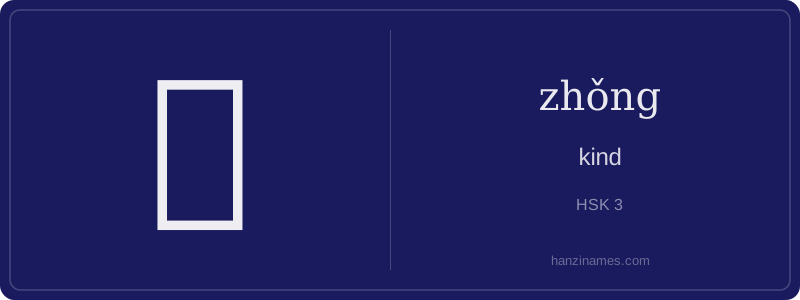
种 is ubiquitous in daily Chinese: from supermarket labels (有机种子 yǒujī zhǒngzi, 'organic seeds') to policy documents (民族种类 mínzú zhǒnglèi, 'ethnic categories'). It appears in the foundational idiom ‘种瓜得瓜,种豆得豆’ (zhòng guā dé guā, zhòng dòu dé dòu — 'sow melons, reap melons; sow beans, reap beans'), recorded in the 6th-century agricultural manual Qimin Yaoshu, emphasizing karmic cause-and-effect. The phrase remains widely quoted in education and media today.
Graphically, 种 is a phono-semantic compound: 禾 (hé, 'grain') as the semantic radical signals its agricultural roots, while 重 (zhòng, 'heavy') provides phonetic hint. First attested in seal script (c. 3rd century BCE), it evolved from earlier forms depicting grain stalks with emphasis on weighty, fertile potential — not a pictograph of a literal seed, but a conceptual symbol of generative substance.
The character 种 (zhǒng) opens a window into the Chinese worldview where classification and origin are deeply intertwined. Unlike English’s rigid separation of ‘type’ and ‘seed’, Chinese sees categories as living, generative entities — a ‘kind’ is not just a label but something that grows, reproduces, and carries lineage. This reflects Confucian and Daoist thought: all things belong to natural kinds with inherent tendencies, like seeds destined to become specific plants.
Its dual pronunciation—zhǒng (noun: kind/seed) and zhòng (verb: to plant)—embodies the dynamic unity of being and becoming. A seed (种) is both static essence and active potential; to plant (种) is to initiate continuity. This mirrors the classical ideal of ‘nurturing one’s nature’ (养性), where identity is cultivated, not fixed — echoing agricultural wisdom central to Chinese civilization for over 4,000 years.
In modern usage, 种 bridges biology, sociology, and ethics: ‘race’ (种族), ‘species’ (物种), and ‘seed’ (种子) share the same root, revealing how Chinese conceptualizes human diversity and ecological relationships through agrarian metaphors. Even digital life adopts this logic — ‘data seeding’ (数据种入) borrows the verb form. This linguistic cohesion signals a worldview where categorization is never abstract, but always rooted in growth, responsibility, and interdependence.
Example Sentences
Common Compounds
Similar Characters — Don't Mix These Up
Your First Step into Chinese Culture: Get a Chinese Name
Every journey into Chinese begins with a name. Use our free Chinese name generator to create a meaningful, personalized Chinese name that fits you perfectly.
Get My Chinese Name →