其
Character Story & Explanation
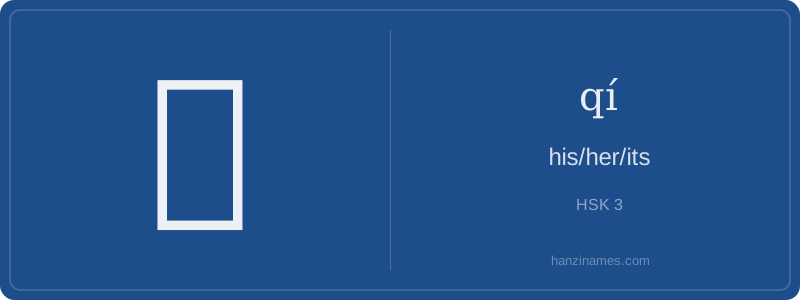
In contemporary Mandarin, 其 appears most frequently in formal writing, academic texts, and set phrases—rarely in casual speech. It’s essential in idioms like 其乐无穷 (qí lè wú qióng, 'endless joy') and classical constructions such as 其实 (qíshí, 'actually, in fact'), where it serves as a sentence-initial particle adding nuance. Historically, it was central to Classical Chinese grammar, appearing in over 90% of Warring States philosophical texts as a core anaphoric and modal marker.
The character’s form has no verified pictographic origin—it evolved from earlier seal script shapes with uncertain roots. Scholars agree its structure (radical 八 + components) reflects phonetic-semantic compound development, not depiction. Today, Chinese speakers use 其 instinctively in written contexts like news headlines ('其影响广泛') or legal documents ('当事人应承担其责任'), relying on its precise, impersonal tone.
As an archaeologist brushing dust from a Han dynasty bamboo slip, I find 其 inscribed in elegant clerical script—not as a simple possessive, but as a grammatical keystone. Its earliest attested uses in pre-Qin texts like the Book of Documents show it functioning as a demonstrative ('that', 'such') and later evolving into a versatile pronoun and particle. Unlike pictographic characters, 其 bears no literal image of ownership; its power lies in syntactic abstraction—marking reference, emphasis, or hypothetical condition.
This character never meant only 'his' in isolation. In classical Chinese, 其 always depends on context: it points back to a previously mentioned noun (e.g., 'the ruler—his virtue'), signals rhetorical questions ('how could he know?'), or introduces subjunctive clauses ('if he were to act…'). Its grammatical elasticity made it indispensable across millennia—from oracle-bone inscriptions’ sparse syntax to Tang poetry’s condensed elegance.
Excavations at Mawangdui revealed 其 used over 1,200 times in the *Huangdi Neijing* medical manuscripts—not to denote possession, but to embed clinical reasoning: 'When the pulse is floating, its disease resides in the exterior.' Here, 其 anchors logical causality, not personhood. This functional depth explains why modern learners encounter it early (HSK 3): it’s less a lexical item than a grammatical lens through which Chinese logic is focused.
Example Sentences
Common Compounds
Similar Characters — Don't Mix These Up
Your First Step into Chinese Culture: Get a Chinese Name
Every journey into Chinese begins with a name. Use our free Chinese name generator to create a meaningful, personalized Chinese name that fits you perfectly.
Get My Chinese Name →