平
Character Story & Explanation
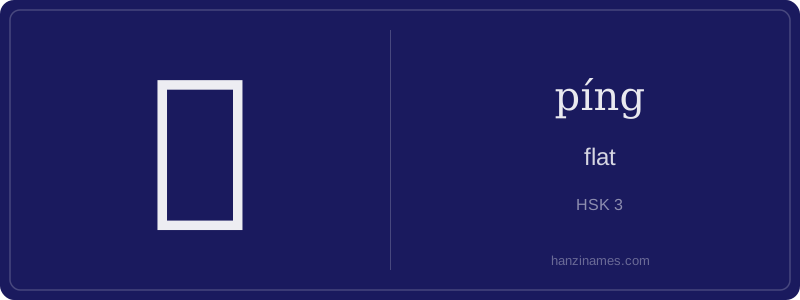
平 is ubiquitous in modern Chinese life: it appears in daily phrases like 平安 (píng’ān, ‘safety/well-being’)—a common New Year greeting—and in official terms like 公平 (gōngpíng, ‘fairness’), enshrined in China’s Constitution. The idiom 风平浪静 (fēng píng làng jìng, ‘wind still, waves calm’) metaphorically denotes tranquility or resolution of conflict, widely used in news and literature. Historically, 平 was inscribed on Han dynasty bronze mirrors and Tang legal documents to signify impartial judgment.
Archaeologically, 平 first appears in seal script (c. 3rd century BCE) as a stylized depiction of a flat, extended surface—likely derived from a pictograph of a leveled earth platform. Its structure (广 + 一 + 丷) reflects the radical 广 (‘broad shelter’) above a horizontal line (一, ‘flatness’) and two downward strokes (丷), suggesting evenness across space. No oracle bone form survives, but its consistency across scripts confirms its early semantic stability.
The Chinese character 平 (píng) conveys the core idea of 'flat'—but extends far beyond surface geometry. In physical terms, it describes level ground or smooth surfaces; linguistically, it underpins concepts like peace (和平), equality (平等), and calmness (平静). Unlike English ‘flat’, which often carries neutral or even negative connotations (e.g., ‘flat soda’), 平 is overwhelmingly positive in Chinese, evoking stability, fairness, and harmony—values deeply embedded in Confucian and Daoist thought.
Western equivalents like ‘flat’ (English), ‘plano’ (Spanish), or ‘eben’ (German) emphasize two-dimensionality or lack of variation—but rarely carry moral weight. In contrast, 平 appears in foundational ethical terms: 平等 (equality) reflects a social ideal central to modern Chinese law and education, while 太平 (‘great peace’) was a dynastic motto for centuries. This semantic breadth reveals how Chinese characters encode philosophy directly into vocabulary.
Culturally, 平 resonates with Western ideals like ‘equilibrium’ (Greek *isonomia*) or ‘shalom’ (Hebrew peace-as-wholeness), but with a distinct emphasis on horizontal balance—not vertical hierarchy. Where ‘justice’ in Anglo-American tradition often implies adjudication, 平 suggests inherent, unforced balance—like water settling naturally. This mirrors Daoist wu wei (effortless action) and contrasts with Aristotelian ‘just mean’, which requires active calibration. Thus, 平 isn’t just a descriptor—it’s an ethical posture.
Example Sentences
Common Compounds
Similar Characters — Don't Mix These Up
Your First Step into Chinese Culture: Get a Chinese Name
Every journey into Chinese begins with a name. Use our free Chinese name generator to create a meaningful, personalized Chinese name that fits you perfectly.
Get My Chinese Name →