相
Character Story & Explanation
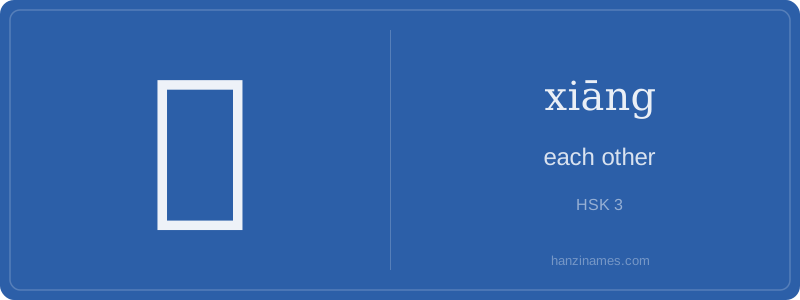
Historically, 相 appears in early texts like the *Zuo Zhuan* (c. 4th century BCE) as a verb meaning 'to observe closely' or 'to assess' — notably in political contexts, such as ministers 'observing' (xiàng) omens or character. By the Tang dynasty, its reciprocal use (xiāng) dominated poetry and prose: Du Fu wrote 相见时难别亦难 ('Meeting each other is hard; parting is hard too'), cementing xiāng as the standard marker for mutual action. Today, it’s indispensable in daily speech — from texting 我们互相帮助 (we help each other) to formal documents using 相关 (related).
The character’s form combines 木 (wood/tree) and 目 (eye) — not a pictograph, but a phono-semantic compound. The 木 component originally provided sound (archaic *sjaŋ*), while 目 indicated meaning related to seeing or perception. This structure is well-documented in Shuōwén Jiězì (121 CE), China’s earliest dictionary, which defines 相 as 'to observe carefully'. No oracle bone evidence exists — its earliest attestation is in bronze inscriptions.
As a detective tracing 相’s evolution, I begin with its bronze script origins: a left-side ‘wood’ (木) radical paired with a right-side ‘eye’ (目), suggesting observation or mutual seeing — not merely 'looking', but looking *at each other*. This visual reciprocity seeded the core meaning of mutual action. By the Han dynasty, 相 had solidified as a grammatical marker for reciprocal verbs, like 'help each other' or 'see each other', distinct from unilateral actions.
The dual pronunciation xiāng/xiàng reflects a functional split rooted in classical usage: xiāng denotes relational, dynamic interaction (e.g., 相爱 — love each other), while xiàng marks static observation or appearance (e.g., 相貌 — facial features). This phonological bifurcation isn’t arbitrary — it mirrors how Chinese historically encoded grammatical aspect through tone and phonation, long before modern dictionaries standardized it.
Crucially, 相 never meant 'each other' in isolation; it only conveys reciprocity when attached to verbs (e.g., 相见, 相助). Its power lies in syntactic partnership — like a linguistic lens that refracts a verb into mutual space. Even today, removing 相 from 相信 (to trust *each other* vs. 信任 — to trust *someone*) shifts semantic weight from relational depth to hierarchical assurance. That nuance is why HSK 3 learners must treat it as a relational operator — not a standalone noun.
Example Sentences
Common Compounds
Similar Characters — Don't Mix These Up
Your First Step into Chinese Culture: Get a Chinese Name
Every journey into Chinese begins with a name. Use our free Chinese name generator to create a meaningful, personalized Chinese name that fits you perfectly.
Get My Chinese Name →