假
Character Story & Explanation
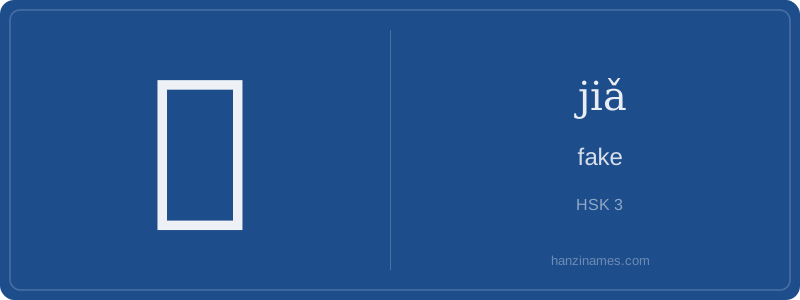
In daily life, 假 appears constantly: on anti-counterfeiting campaigns by China’s State Administration for Market Regulation, in WeChat warnings about 'fake health supplements', and in idioms like 弄虚作假 (nòng xū zuò jiǎ, 'to fabricate falsehoods')—a phrase frequently cited in government integrity reports since the 2010s. It’s also central to HSK-3 vocabulary lists and widely tested in listening sections due to its tonal ambiguity.
The character’s form is not pictographic but phono-semantic: left side 亻 (person) indicates human involvement; right side is a simplified variant of 暇 (xiá), originally meaning 'leisure'—chosen for sound, not meaning. No oracle bone or bronze script forms survive for 假; it first appears reliably in seal script (c. 3rd century BCE), already with dual readings.
The character 假 (jiǎ) is a cornerstone of Chinese semantic duality—its core meaning 'fake' or 'false' reflects deep cultural awareness of authenticity, from ancient philosophical debates about truth (e.g., Daoist and Mohist texts questioning perception) to modern concerns about counterfeit goods. Its radical 亻 (person) hints at human agency in deception or pretense, while the phonetic component 暇 (xiá, 'leisure') historically provided sound but later diverged—showing how pronunciation shifts shaped meaning.
Interestingly, 假 also carries the homophone jià ('holiday'), where 'leisure time' evolved into 'time off'. This dual reading isn’t arbitrary: in classical texts like the *Book of Rites*, 假 denoted 'temporary delegation of authority', implying both provisional status (hence 'not real') and sanctioned pause (hence 'break'). The character thus embodies a linguistic bridge between falsehood and permission.
For learners, mastering 假 means navigating tone-dependent meaning: jiǎ (third tone) almost always signals artifice—'fake ID', 'phony smile'—while jià (fourth tone) appears only in time-related contexts like 放假 (fàng jià, 'to take a holiday'). Confusing them causes real-world blunders: saying 'I’m taking fake' instead of 'I’m on break' can spark confusion—or laughter—at the office.
Example Sentences
Common Compounds
Similar Characters — Don't Mix These Up
Your First Step into Chinese Culture: Get a Chinese Name
Every journey into Chinese begins with a name. Use our free Chinese name generator to create a meaningful, personalized Chinese name that fits you perfectly.
Get My Chinese Name →