典
Character Story & Explanation
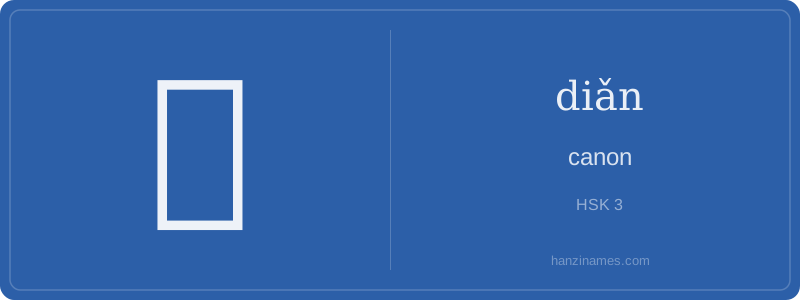
In modern Chinese, 典 appears most frequently in formal, literary, or academic contexts—especially in compounds like 经典 (jīngdiǎn, 'classic'), 典范 (diǎnfàn, 'model/exemplar'), and 引经据典 (yǐn jīng jù diǎn, 'to quote classics and authorities'). It’s central to education: HSK Level 3 learners encounter it in reading passages about cultural heritage, and it appears in official documents describing national standards (e.g., 国家标准典, though rare, reflects its normative force).
The character’s earliest secure attestation is in Warring States bamboo manuscripts (4th c. BCE), where it consistently denotes authoritative texts or rituals. Its seal script form shows 曰 (a mouth/‘saying’) beneath 八 (interpreted not as 'eight' but as a diverging, stabilizing element—like hands holding open a scroll). No oracle bone form exists; it emerged later as writing systems matured to record codified knowledge.
As an archaeologist brushing dust from a Han dynasty bamboo slip, I find 典 inscribed with solemn precision—not as a mere word, but as a cultural artifact. Its eight strokes form a compact yet weighty structure: the upper 八 (bā, 'eight') radical—often interpreted as a symbol of division or distinction—and the lower 曰 (yuē, 'to say'), now stylized as a bounded rectangle. This combination signals something formally declared, authoritatively spoken, and thus preserved.
Excavations at Mawangdui revealed early uses of 典 in texts like the *Zhouli* (Rites of Zhou), where it denoted canonical administrative statutes—binding precedents carved in bronze or written on silk. Unlike ephemeral decrees, a 典 was meant to endure: copied, recited, and ritually consulted. Its very shape suggests containment and authority—the ‘saying’ placed under deliberate, structural control.
The character’s stability across 2,200 years is remarkable. From oracle-bone script (where its earliest attested form is absent) to modern print, 典 never simplified dramatically—it resisted change because its function demanded continuity. To handle a 典 was to touch institutional memory; to cite one was to invoke legitimacy. Today, that resonance remains: calling something a 典 isn’t descriptive—it’s a verdict of enduring value.
Example Sentences
Common Compounds
Similar Characters — Don't Mix These Up
Your First Step into Chinese Culture: Get a Chinese Name
Every journey into Chinese begins with a name. Use our free Chinese name generator to create a meaningful, personalized Chinese name that fits you perfectly.
Get My Chinese Name →