冒
Character Story & Explanation
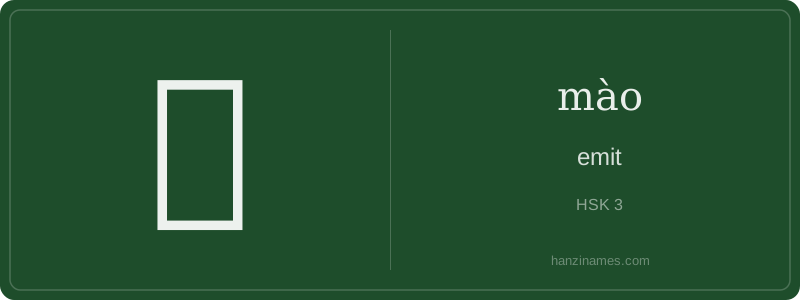
In daily life, 冒 appears frequently in compound verbs like 冒烟 (mào yān, 'to smoke/smoke up'), 冒泡 (mào pào, 'to bubble up'), and 冒险 (mào xiǎn, 'to take a risk'). It’s central to the HSK-3 idiom 冒失 (mào shī, 'rash/impulsive'), reflecting cultural awareness of balanced initiative. Historically, 冒 appears in early bronze inscriptions with its current structure, consistently used for 'emission'—e.g., in Tang dynasty texts describing incense smoke rising from altars.
The character’s form is documented as a pictograph: the top two dots represent vapor or steam; the middle part (冂) suggests an opening or container; and the bottom 元 (yuán) originally depicted a person’s head—symbolizing something emanating *from* a source. Modern analysis confirms this as a semantic-phonetic compound, with 元 providing sound (ancient pronunciation close to *mào*) and the upper elements conveying meaning.
Imagine standing in a bustling Chengdu teahouse on a chilly winter morning. Steam rises vigorously from a freshly poured cup of jasmine tea—tiny droplets hover, then vanish into the warm air. This visible, energetic release is exactly what 冒 (mào) captures: the physical act of something emerging or escaping outward—steam, smoke, sound, even risk. It’s not passive; it’s dynamic emission.
Unlike generic ‘to appear’, 冒 implies an upward, often sudden or noticeable outflow—like steam冒ing from a kettle, sweat冒ing on a runner’s brow, or even bold ideas冒ing up in conversation. Its radical 冂 (a 'downward open frame') hints at containment being breached—something pushing out from within boundaries.
In modern usage, 冒 carries subtle connotations of spontaneity and slight unpredictability. When someone says 他冒出个主意 (tā mào chū gè zhǔyì), it suggests an idea surfaced unbidden—not carefully planned, but vividly present. This nuance makes 冒 essential for describing natural phenomena, emotional reactions, and even social behaviors like speaking up without hesitation.
Example Sentences
Common Compounds
Similar Characters — Don't Mix These Up
Your First Step into Chinese Culture: Get a Chinese Name
Every journey into Chinese begins with a name. Use our free Chinese name generator to create a meaningful, personalized Chinese name that fits you perfectly.
Get My Chinese Name →