冰
Character Story & Explanation
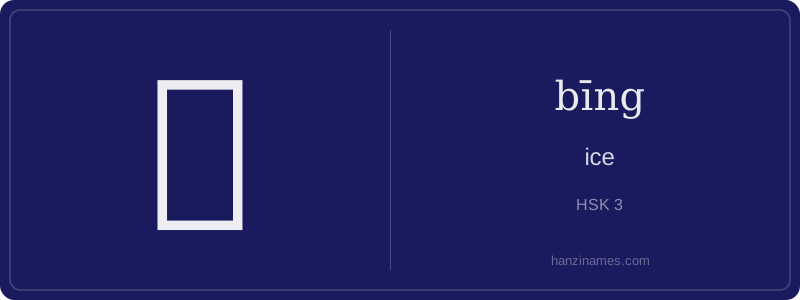
冰 appears in countless everyday contexts: beverage menus list 冰咖啡 (bīng kāfēi, iced coffee); weather reports say 今日有冰 (jīnrì yǒu bīng, ‘ice today’) during winter freezes; and the idiom 冰清玉洁 (bīng qīng yù jié, ‘as pure as ice and jade’) has been used since the Han dynasty to praise moral purity. The character also features in historical texts like the *Book of Rites*, describing ice storage for summer use in royal courts.
The earliest documented form of 冰 appears in bronze inscriptions (c. 1000 BCE) as a pictograph combining 冫 and 水, clearly representing frozen water. Unlike later simplifications, early forms emphasized droplets solidifying — a direct visual metaphor confirmed by paleographic studies (e.g., *Chinese Writing* by Qiu Xigui). No oracle-bone version survives, but bronze-era usage is well attested.
Hi students! Let’s explore 冰 (bīng), meaning 'ice'. It’s a Level 3 HSK character — very practical and frequently used. Notice its radical 冫 (‘ice’ or ‘cold’ radical), which appears in many temperature-related characters like 冷 (lěng, cold) and 凉 (liáng, cool). This radical always sits on the left and signals that the character relates to low temperature or frozen states.
The right side of 冰 is 水 (shuǐ, water) simplified — but not literally the full water character. In modern script, it’s written as 氵as a left-side variant, yet here it’s stylized as 丶 + 一 + 丿 — reflecting how ice forms when water solidifies. Six strokes total: two for the radical 冫 (dot + downward stroke), then four for the right component. Practice writing it slowly: dot, downward stroke, then top dot, horizontal, slash, and final dot.
Remember: 冰 is not just about frozen water — it carries cultural weight. In Chinese, we say 冰镇 (bīng zhèn, ‘ice-chilled’) for drinks, 冰箱 (bīng xiāng, ‘ice box’ → refrigerator), and even use it metaphorically, like 冰冷 (bīng lěng, ‘icy cold’) to describe an emotionless tone. It’s concrete, visual, and deeply embedded in daily speech — making it a great anchor for building vocabulary around weather, food, and feelings.
Example Sentences
Common Compounds
Similar Characters — Don't Mix These Up
Your First Step into Chinese Culture: Get a Chinese Name
Every journey into Chinese begins with a name. Use our free Chinese name generator to create a meaningful, personalized Chinese name that fits you perfectly.
Get My Chinese Name →