刮
Character Story & Explanation
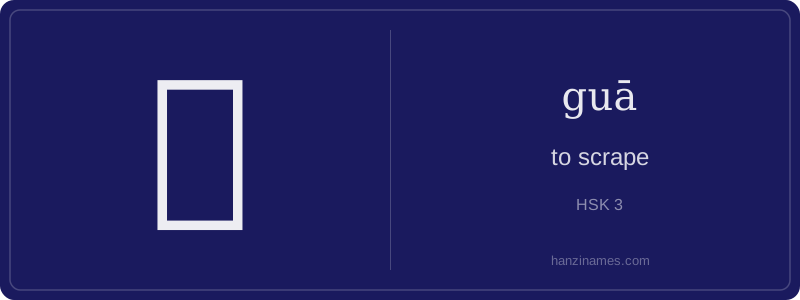
In daily life, 刮 most commonly appears in 刮风 (guā fēng, 'the wind blows strongly') and 刮胡子 (guā húzi, 'to shave'). Historically, it’s central to traditional therapy: 刮痧 (guāshā) has been practiced since the Ming Dynasty and is recognized by China’s National Administration of Traditional Chinese Medicine as a regulated external treatment. Modern usage includes industrial contexts—e.g., 刮刀 (guādāo, 'scraper blade') in printing and coating industries.
The character’s written form shows no oracle-bone or bronze-inscription origin; it first appears in standardized Qin-era small seal script. Its left side 又 (yòu) serves as a phonetic component, while the right-side 刂 (knife radical) unambiguously signals its core meaning: an action performed with a sharp-edged tool. No pictographic sun or tree here—just clear, functional orthography.
Our detective begins at the crime scene: the character 刮 (guā), an 8-stroke verb meaning 'to scrape'. Its right-hand component 刂—the 'knife' radical—immediately signals a sharp, cutting action. This isn’t abstract symbolism: in ancient Chinese script forms (like seal script), the left side was originally 朶 (duǒ), a phonetic hint now simplified to 又 (yòu), while the knife radical anchors its physical, tool-based meaning. The character’s design is functional—not pictorial, but morphophonemic: sound + semantic cue.
Zooming in on historical usage, 刮 appears early in medical and craft texts. The *Huangdi Neijing* (c. 3rd century BCE) references ‘刮痧’ (guāshā)—scraping the skin with a smooth tool to promote circulation—a practice still clinically documented today. Unlike characters born from oracle-bone pictographs, 刮 evolved through clerical script standardization, where efficiency overrode visual literalism. Its modern form reflects bureaucratic refinement, not ancient imagery.
The detective notes a linguistic fingerprint: 刮 almost never stands alone in speech. It’s a bound verb requiring objects (e.g., 刮胡子, 刮风) or appearing in compound nouns (刮板, 刮刀). Its tone (first tone, guā) is stable across dialects—unlike homophones like 瓜 (guā, 'melon') or 挂 (guà, 'to hang'), which share pronunciation but lack the knife radical’s semantic gravity. This consistency makes 刮 a reliable lexical marker for friction, removal, or forceful contact.
Example Sentences
Common Compounds
Similar Characters — Don't Mix These Up
Your First Step into Chinese Culture: Get a Chinese Name
Every journey into Chinese begins with a name. Use our free Chinese name generator to create a meaningful, personalized Chinese name that fits you perfectly.
Get My Chinese Name →