刷
Character Story & Explanation
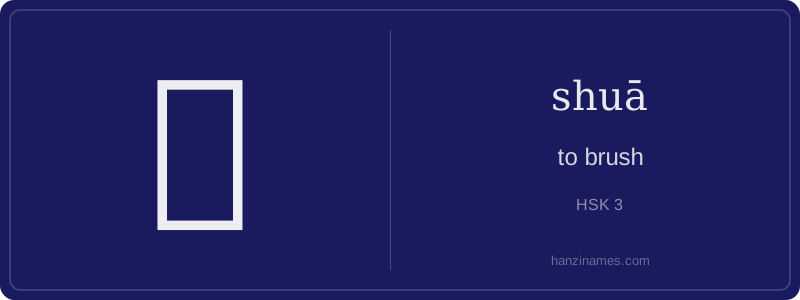
In modern Chinese, 刷 is ubiquitous in daily verbs: brushing teeth (刷牙 shuā yá), swiping transit cards (刷卡 shuā kǎ), and scrolling feeds (刷手机 shuā shǒujī—‘brushing the phone’, i.e., mindlessly scrolling). It appears in the common phrase 刷存在感 (shuā cúnzài gǎn), meaning ‘to seek attention’—a digital-age idiom documented in China’s 2017 Baidu Hot Words Report. Historically, it appeared in Song dynasty texts describing ink-brush techniques for calligraphy and painting.
The character is not pictographic—it evolved from bronze script forms combining 師 (master) and 刂 (knife/cutting tool), later simplified. Its current shape reflects standardization under the 1956 Script Reform. Today, Chinese students learn it in HSK 3 textbooks as a key verb for hygiene and digital interaction, not as a noun for ‘brush’—which is more commonly 笔 (bǐ) or 刷子 (shuāzi).
As an archaeologist sifting through layers of linguistic sediment, I uncover 刷 not as a static glyph but as a dynamic artifact of action—its sharp 刂 (knife) radical whispering of cutting-edge motion, while the upper component 水 (shuǐ, water) evolved into 師 (shī, master/teacher) in seal script, suggesting skilled, repetitive application—like a master brushman laying down ink with precision and authority. This is not mere tool-naming; it’s verb-as-ritual.
The dual pronunciations shuā (common, imperative/actional) and shuà (rarer, often in dialect or fossilized compounds like 刷白 shuàbái ‘bleached white’) reveal phonological stratification—like weathered inscriptions where tone shifts mark temporal erosion. The character’s 8-stroke form crystallized during the Han dynasty clerical script phase, shedding earlier pictographic ambiguity for functional clarity: a hand wielding a tool that both coats and cleans.
Excavating usage across Tang poetry, Song painting manuals, and Ming vernacular fiction, 刷 consistently denotes *applied surface action*: ink brushed onto silk, dust brushed off robes, even slander ‘brushed’ onto reputations (e.g., 刷黑 ‘to smear/blacken’). Its semantic field bridges craft, hygiene, and digital metaphor—proving ancient strokes adapt seamlessly to new substrates, from bamboo slips to smartphone screens.
Example Sentences
Common Compounds
Similar Characters — Don't Mix These Up
Your First Step into Chinese Culture: Get a Chinese Name
Every journey into Chinese begins with a name. Use our free Chinese name generator to create a meaningful, personalized Chinese name that fits you perfectly.
Get My Chinese Name →