刻
Character Story & Explanation
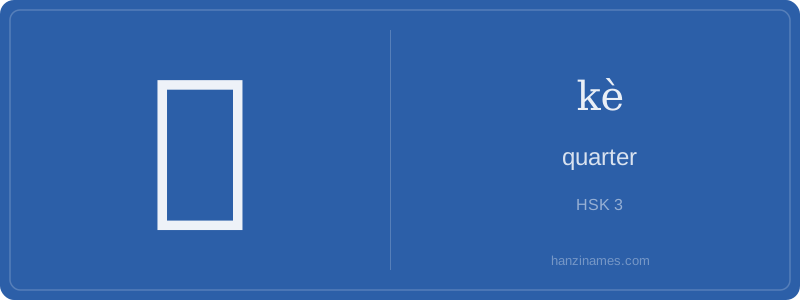
In modern Chinese daily life, 刻 appears frequently in public time announcements: train stations, airports, and TV news all use phrases like ‘三刻钟后’ (sān kè zhōng hòu, ‘in 45 minutes’) or ‘四十五分’ (sìshíwǔ fēn) interchangeably — though 刻 feels slightly more formal or literary. A well-documented idiom is 深刻 (shēnkè, ‘profound’), where 刻 conveys ‘deeply engraved’ meaning lasting mental impact. The phrase 刻不容缓 (kè bù róng huǎn, ‘not a moment to spare’) has been recorded since at least the Ming dynasty in military texts, stressing urgency as something carved in stone.
The character 刻 first appeared in seal script (c. 3rd c. BCE) as a compound of 亥 (hài, phonetic component, later simplified to 亥→㔾) and 刂 (dāo, ‘knife’ radical), clearly indicating its meaning ‘to carve’. There is no pictographic origin — it’s a semantic-phonetic compound, not a picture of a clock or sundial.
Hi students! Today we’re learning 刻 (kè), an HSK Level 3 character with 8 strokes and the knife radical 刂. Though you’ll often hear it means ‘quarter’ (as in ‘a quarter of an hour’), that’s actually just one common usage — not its core meaning. Its original sense is ‘to carve’ or ‘to engrave’, which evolved into ideas of precision, intensity, and time measurement. Think of carving a mark into wood: each cut leaves a permanent, exact impression — just like marking time.
When used for time, 刻 specifically means 15 minutes — one-quarter of an hour — because traditional Chinese timekeeping divided the two-hour shí (時) into four equal parts, each called a 刻. So 两点一刻 (liǎng diǎn yī kè) literally means ‘two o’clock one刻’, i.e., 2:15. This usage remains standard in formal speech, train announcements, and written schedules across China and Taiwan.
Don’t confuse 刻 with general time words like 分 (fēn, ‘minute’) or 时 (shí, ‘hour’). 刻 only appears in fixed 15-minute increments — never 5 or 10 minutes. It’s also used in powerful abstract expressions like 刻苦 (kèkǔ, ‘diligent’) — literally ‘carve bitterness’, meaning to work so hard you engrave perseverance into yourself. That vivid imagery helps make the character stick!
Example Sentences
Common Compounds
Similar Characters — Don't Mix These Up
Your First Step into Chinese Culture: Get a Chinese Name
Every journey into Chinese begins with a name. Use our free Chinese name generator to create a meaningful, personalized Chinese name that fits you perfectly.
Get My Chinese Name →