刚
Character Story & Explanation
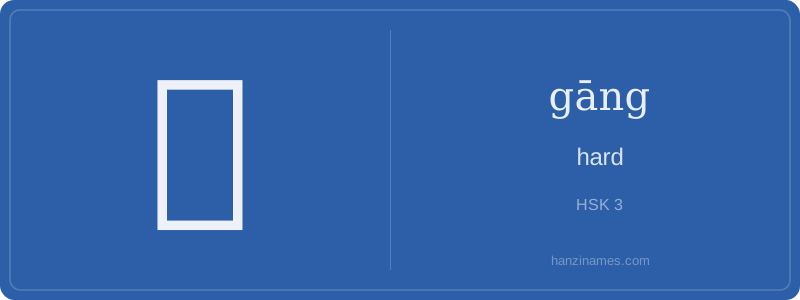
刚 is ubiquitous in modern Mandarin speech and writing—most commonly as an adverb meaning 'just' or 'a moment ago' (e.g., 他刚走 'He just left'). It appears in HSK 3 vocabulary lists and daily news headlines, such as 刚刚发布的政策 ('the policy just released'). Historically, it's documented in the Shuōwén Jiězì (121 CE) as 'strong, hard, unyielding', linked to metal hardness and moral rigidity. The idiom 刚正不阿 ('upright and unbending') has been used since the Song dynasty to describe incorruptible officials.
The character’s structure is not pictographic but phonosemantic: the left side 冏 (now written as 冈 in simplified form) provides the sound gāng, while the right-side knife radical 刂 conveys association with sharpness, strength, and decisive action—consistent with its earliest attested uses in bronze inscriptions and early dictionaries.
Our detective work begins with the modern form of 刚: six strokes, a left-side ‘strong’ component (冈 gāng, meaning 'ridge' or 'mountain pass') fused with the right-side knife radical (刂). This isn’t a pictograph of hardness itself—but a phonosemantic compound: the left hints at sound (gāng), the right signals association with cutting, sharpness, and by extension, firmness and unyielding quality. Early seal script forms already show this structural logic, confirming its ancient design as a conceptual blend—not a visual depiction of hardness.
The knife radical (刂) is key to unlocking 刚’s semantic range. In classical Chinese, characters with 刂 often relate to action, precision, or intensity—think 刻 (kè, 'to engrave'), 利 (lì, 'sharp/advantageous'). So 刚 doesn’t just mean 'hard' like stone—it implies *hard-edged* qualities: resolute, abrupt, freshly applied, or newly emerged. This explains why it modifies verbs ('just now') and adjectives ('stiff') alike: it injects immediacy and inflexibility into context.
Over centuries, 刚 evolved from a primarily physical descriptor (e.g., 刚铁 'hard iron', found in Han dynasty metallurgical texts) to a versatile grammatical force. By the Tang and Song dynasties, its temporal use—'just' or 'a moment ago'—was standardized in poetry and prose. Today, it straddles lexical and functional roles: an adjective, an adverb, and even part of fixed expressions like 刚愎自用 ('stubbornly self-opinionated'), cited in the Records of the Grand Historian. Its persistence reflects how Chinese abstracts concrete traits—like sharpness—into behavioral and temporal concepts.
Example Sentences
Common Compounds
Similar Characters — Don't Mix These Up
Your First Step into Chinese Culture: Get a Chinese Name
Every journey into Chinese begins with a name. Use our free Chinese name generator to create a meaningful, personalized Chinese name that fits you perfectly.
Get My Chinese Name →