又
Character Story & Explanation
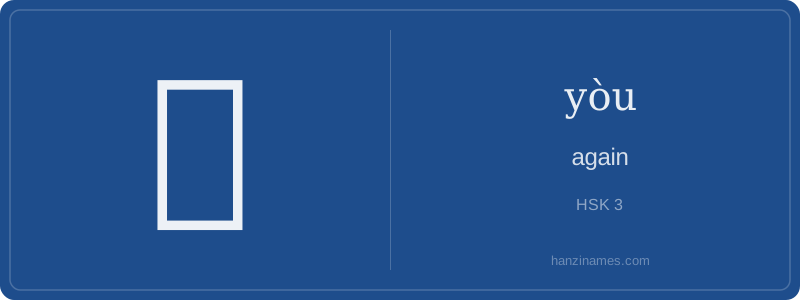
In daily Mandarin, 又 is indispensable for expressing repetition, surprise, or accumulated states—especially in spoken grammar. It appears in the ubiquitous pattern '又…又…' (both… and…), as in 又便宜又好吃 ('cheap and delicious'), and in expressions of ironic recurrence: 又来了!('Here we go again!'). Historically, it's documented in the *Zuo Zhuan* (4th c. BCE) marking repeated actions by rulers and ministers, confirming its grammatical role over 2,400 years ago.
The earliest form of 又 is confirmed in oracle-bone script (c. 1200 BCE) as a clear pictograph of a right hand, with a curved line for the forearm and a straight stroke for fingers. No dispute exists among paleographers: it is one of the oldest attested hand symbols in Chinese writing, later phonetically borrowed (jiǎjiè) to represent the homophonous yòu meaning 'again'.
As an archaeologist brushing dust from a Shang dynasty oracle bone, I found 又 etched not as 'again'—a meaning it acquired later—but as a pictograph of a right hand, its two strokes representing the wrist and outstretched fingers. Early inscriptions used it to denote 'to assist' or 'to have', often in ritual contexts: 'the king 又 (has) auspicious signs'. Its simplicity belies deep functional roots—this was not abstract repetition, but embodied action, grasp, and agency.
By the Warring States period, 又 began shifting semantically. Scribes repurposed the hand symbol to mark recurrence—perhaps because 'reaching again' implied repetition, or because its brevity suited grammatical particles. In bamboo-slip texts like the *Chu Silk Manuscript*, 又 appears mid-sentence before verbs ('又见' — 'again sees'), functioning much as it does today: a lightweight, high-frequency adverb anchoring temporal continuity without inflection.
This character’s resilience lies in its dual nature: it is both fossil and tool. Unlike complex ideographs that faded, 又 survived because it was stripped down—just two strokes, no ambiguity, maximal utility. It became the linguistic equivalent of a multitool: used in compound formation (e.g., 又大又圆), in classical parallel constructions, and as a grammatical glue in modern Mandarin. Its archaeological journey mirrors language itself: pragmatic adaptation over poetic origin.
Example Sentences
Common Compounds
Similar Characters — Don't Mix These Up
Your First Step into Chinese Culture: Get a Chinese Name
Every journey into Chinese begins with a name. Use our free Chinese name generator to create a meaningful, personalized Chinese name that fits you perfectly.
Get My Chinese Name →