口
Character Story & Explanation
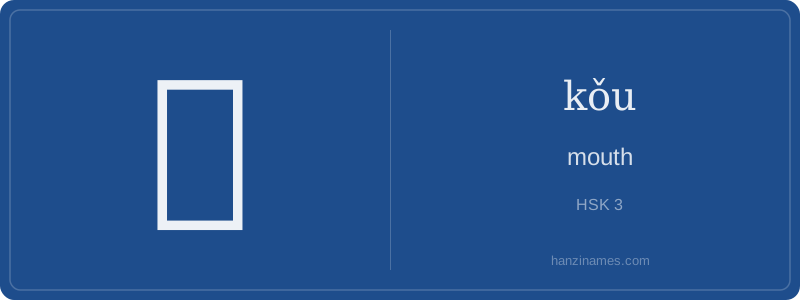
In Beijing’s bustling Wangfujing snack street, vendors shout “来一口!(Lái yì kǒu!) — ‘Try a bite!’ — holding skewers of candied hawthorn. Here, 口 functions as a measure word for small edible portions — a usage documented since the Ming dynasty and still standard in spoken Mandarin. Common phrases like 口才 (kǒu cái, eloquence), 口音 (kǒu yīn, accent), and 出口 (chūkǒu, export) all derive from 口’s core meaning of 'mouth' as the source of speech and exchange.
Documented since oracle bone inscriptions (c. 1250 BCE), 口 is a canonical pictograph: its square shape with an open center directly mirrors the outline of a human mouth seen frontally. No reconstruction or interpretation is needed — it’s one of the clearest surviving examples of early Chinese pictographic writing, confirmed by archaeological consensus and linguistic scholarship.
The character 口 (kǒu) is one of the most fundamental and ancient Chinese characters — a clear pictograph of a mouth, drawn with three strokes to suggest lips and an opening. It appears in over 1,000 modern Chinese characters as a radical, often signaling meanings related to speaking, eating, breathing, or entry points. Its simplicity belies its semantic power: whether in words like 咖啡 (kāfēi, coffee) or 可口可乐 (kěkǒu kělè, Coca-Cola), 口 anchors ideas of taste, voice, and human interaction.
As a standalone character, 口 means 'mouth' — but in daily usage, it extends metaphorically to 'opening', 'port', 'entry', or even 'a unit of population' (e.g., 三口人, sān kǒu rén — 'three mouths', meaning 'a family of three'). This polysemy reflects how deeply bodily experience shapes Chinese language structure. Linguists note that 口 is among the top 5 most frequently used radicals in written Chinese, appearing in both formal documents and street signage.
Historically, 口 appears unchanged from early bronze inscriptions (c. 1200 BCE) to today’s standard script — a rare example of visual continuity across 3,000 years. Its stability underscores its conceptual centrality: without the mouth, there is no speech; without speech, no culture. In contemporary China, children learn 口 in Grade 1 not just as vocabulary, but as a building block for literacy — it’s the first radical many recognize in characters like 吃 (chī, to eat), 叫 (jiào, to call), and 名 (míng, name), where sound and identity begin at the mouth.
Example Sentences
Common Compounds
Similar Characters — Don't Mix These Up
Your First Step into Chinese Culture: Get a Chinese Name
Every journey into Chinese begins with a name. Use our free Chinese name generator to create a meaningful, personalized Chinese name that fits you perfectly.
Get My Chinese Name →