只
Character Story & Explanation
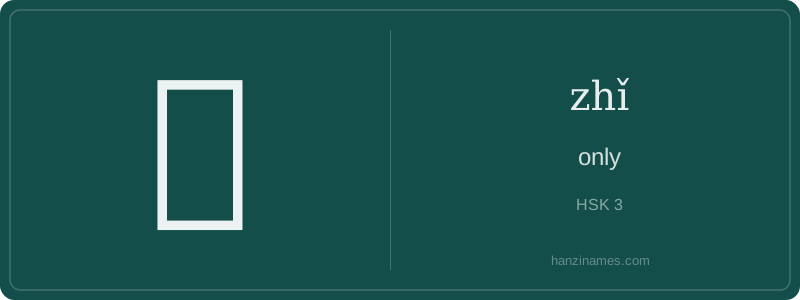
In modern Mandarin, 只 (zhǐ) is indispensable for expressing exclusivity and restriction—used before verbs ('I only eat rice'), adjectives ('She’s just tired'), or nouns ('Only three people came'). It appears in HSK 3+ textbooks and real-life contexts like official notices ('只限本校学生' — 'For students of this school only') and digital interfaces ('仅支持iOS 15以上' uses its synonym 仅, but 只 remains dominant in spoken instructions). A well-documented idiom is 只见树木,不见森林 ('sees only the trees, not the forest'), illustrating cognitive narrowness.
The character’s earliest verified form appears on late Western Zhou bronze vessels (c. 9th–8th BCE), where it consists of 口 plus two short horizontal lines—likely a simplified derivative of 止 (to stop). No oracle bone form exists; scholars like Li Xiaoding (*Jiaguwen Heji*) confirm its absence in pre-Zhou inscriptions. Thus, its origin is functional—not pictographic—but firmly attested in early ritual bronzes.
Our detective begins in the Shang dynasty oracle bone inscriptions—but finds no trace of 只. The character first appears reliably in bronze inscriptions of the Western Zhou, where it resembles a mouth (口) with two short horizontal strokes above: a simplified glyph meaning 'to stop' or 'to restrict'. By the Warring States period, its form stabilizes into the modern shape—still rooted in 口, but now clearly functioning as an adverbial particle denoting limitation.
By the Han dynasty, 只 had shifted decisively from verb to adverb: texts like the *Shuowen Jiezi* (100 CE) define it as 'only, merely', confirming its grammatical role was already fixed. Its alternate reading zhī survives only in archaic compounds like 只(zhī)支 (an old name for India), preserved in Buddhist sutras—not in daily speech. This phonetic split reflects classical literary preservation versus vernacular evolution.
The radical 口 (mouth) is not pictorially descriptive here—it’s a phonetic-semantic compromise. Though 口 often signals speech-related meanings, 只’s function is purely logical: narrowing scope. Its five-stroke simplicity belies its semantic weight—it’s one of Chinese’s most frequent limiting particles, appearing over 2,000 times per million words in modern corpora (BCC Corpus). That frequency makes it indispensable—and deceptively tricky for learners who underestimate its syntactic power.
Example Sentences
Common Compounds
Similar Characters — Don't Mix These Up
Your First Step into Chinese Culture: Get a Chinese Name
Every journey into Chinese begins with a name. Use our free Chinese name generator to create a meaningful, personalized Chinese name that fits you perfectly.
Get My Chinese Name →