史
Character Story & Explanation
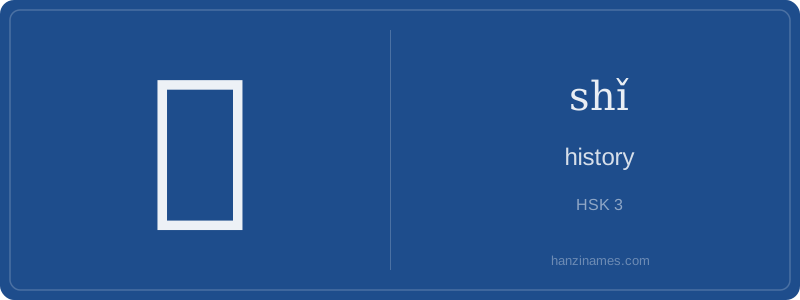
史 is indispensable in modern Chinese: it appears in HSK textbooks, university departments (历史系, 'Department of History'), national exams, and media headlines like '中美关系史' (Sino-U.S. relations history). It anchors core idioms: '青史留名' (to be remembered in history—literally 'leave one’s name in the blue-green historical records') and '史无前例' ('unprecedented,' lit. 'without precedent in history'). Historians still cite Sima Qian’s *Shǐjì* (Records of the Grand Historian, c. 94 BCE), the foundational text that established 史 as both profession and discipline.
The character’s earliest verified form (c. 1200 BCE oracle bone script) depicts a hand holding a writing instrument beside 口—confirmed by scholars like Li Xiaoding and the *Jiǎgǔwén Hejí*. No sun, no mountain: it’s literally 'scribe'—a function so vital it became synonymous with recorded time itself. Today, students practice its five strokes daily, knowing each line echoes millennia of deliberate, ethical documentation.
Our detective work begins with the oracle-bone and bronze inscriptions of the Shang and Zhou dynasties—where 史 first appears not as a pictograph of history, but as a scribe’s title. Early forms show a hand holding a writing brush (later stylized) beside a mouth (口), reflecting the official’s dual role: recording spoken decrees and inscribing them on bones or bronze. This wasn’t abstract ‘history’ yet—it was the act of authoritative documentation.
By the Warring States period, 史 evolved from a job title into a conceptual noun. The *Zuo Zhuan* and *Guoyu* use it to denote both court historians and their written records. The radical 口 remained—not because history is oral, but because early historiography centered on reporting speeches, oaths, and royal pronouncements verbatim. The five-stroke simplicity belies its weight: every stroke anchors authority, accuracy, and continuity.
In seal script, 史 stabilized into its modern shape: 口 at the top, then three horizontal strokes below (一 丨 一), representing orderly record-keeping—lines like bamboo slips stacked chronologically. The final stroke’s slight rightward tilt hints at movement forward in time. Unlike characters born from nature (e.g., 日 for ‘sun’), 史 is a bureaucratic invention: history as institutional memory, not myth. Its endurance proves how deeply Chinese civilization ties truth to written accountability.
Example Sentences
Common Compounds
Similar Characters — Don't Mix These Up
Your First Step into Chinese Culture: Get a Chinese Name
Every journey into Chinese begins with a name. Use our free Chinese name generator to create a meaningful, personalized Chinese name that fits you perfectly.
Get My Chinese Name →