向
Character Story & Explanation
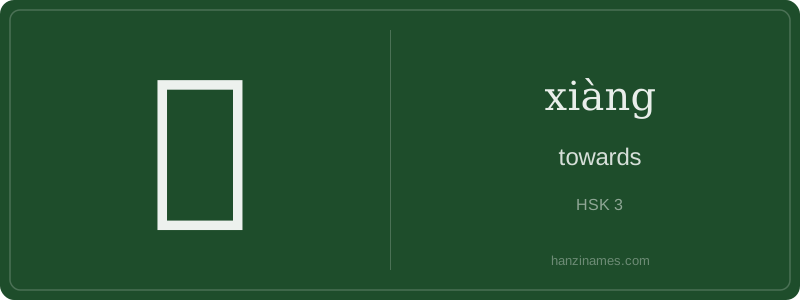
In modern Chinese, 向 appears constantly in functional phrases: asking for directions ('向哪边走?'), reporting news ('向公众通报'), or expressing loyalty ('向党致敬'). It’s central to formal and bureaucratic language—e.g., official documents frequently use 向…报告 (xiàng… bàogào, 'report to…') and 向…申请 (xiàng… shēnqǐng, 'apply to…'). The idiom '向隅而泣' (xiàng yú ér qì), meaning 'to weep alone in a corner', dates back to the Han dynasty and appears in the *Book of Han*, illustrating historical usage in literary contexts.
The character’s earliest attested form appears in bronze inscriptions of the Western Zhou (c. 1046–771 BCE), where it depicted a person facing a dwelling—suggesting orientation toward a place or authority. While its oracle-bone origins are fragmentary, the seal script version clearly shows 口 (representing a marker or entry point) combined with an archer-like component indicating direction—confirming its ancient function as a directional preposition.
Imagine standing at Beijing’s Tiananmen Square at dawn, facing the towering Gate of Heavenly Peace. A tour guide points firmly with her hand—not just to indicate direction, but to embody intention: '向北走' (xiàng běi zǒu)—‘walk towards the north’. The character 向 captures that precise, purposeful orientation—neither vague nor passive, but a conscious movement or focus toward something tangible or abstract.
In Chinese grammar, 向 is a preposition that marks direction, goal, or recipient—like ‘toward’, ‘to’, or ‘at’. It’s essential for expressing intent: not just *where* you go, but *why* and *for whom*. Unlike the static 口 (mouth) radical might suggest, 向 isn’t about speaking—it’s about aiming, aligning, and directing energy, much like an arrow guided by intention.
This directional precision makes 向 indispensable in daily communication: from giving directions ('向左转') to expressing aspirations ('向梦想努力'). Its six-stroke form—beginning with the 口 radical followed by the simplified 'archer’s bow' component (+丿+一)—visually echoes the idea of aiming *from* a point *toward* a target. At HSK Level 3, learners encounter it early because it unlocks relational meaning in verbs, nouns, and idioms alike.
Example Sentences
Common Compounds
Similar Characters — Don't Mix These Up
Your First Step into Chinese Culture: Get a Chinese Name
Every journey into Chinese begins with a name. Use our free Chinese name generator to create a meaningful, personalized Chinese name that fits you perfectly.
Get My Chinese Name →