嘴
Character Story & Explanation
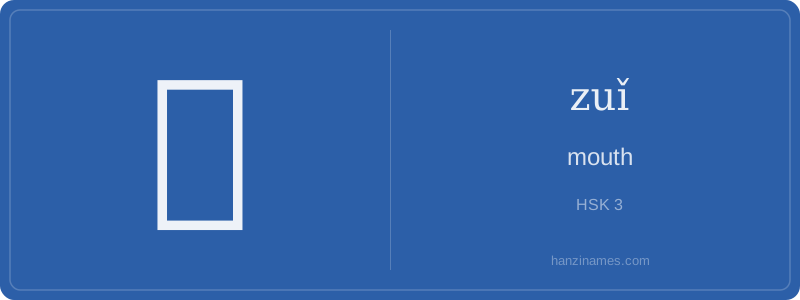
In daily life, 嘴 is indispensable for describing physical speech organs and figurative expression — e.g., 嘴快 (zuǐkuài, 'quick-mouthed') describes someone who speaks impulsively, a trait noted in Ming-dynasty conduct manuals. It appears in idioms like 嘴甜心苦 (zuǐ tián xīn kǔ, 'sweet-mouthed, bitter-hearted'), documented in Qing-era vernacular fiction like Dream of the Red Chamber. Unlike 口, which can mean 'entrance' or 'vocabulary', 嘴 is almost exclusively anatomical or behavioral.
The character has no verified oracle-bone or bronze inscription form; it first appears reliably in Song-dynasty printed texts as a colloquial alternative to 口. Today, Chinese learners practice it in HSK 3 dialogues about food ('用嘴尝一尝' — 'taste with your mouth'), and parents correct children saying '闭上嘴' ('close your mouth') — a phrase ubiquitous in homes and classrooms nationwide.
As a linguistic detective, I begin with the radical: 口 (kǒu), meaning 'mouth' — a foundational pictograph resembling an open mouth, used in over 1,000 characters related to speech, eating, or sound. 嘴 builds upon this base, adding phonetic and semantic layers. Its right side, 舄 (xì, archaic for 'ceremonial shoe'), was repurposed not for meaning but sound — evolving into zuǐ via historical phonetic drift, reflecting how Chinese characters often fuse visual roots with borrowed pronunciation.
The character’s 16 strokes reveal deliberate structure: first the 口 radical (3 strokes), then a complex right component combining (a variant of ‘person’), 冖 (cover), and 八 (dividing). This isn’t random — it mirrors Song–Yuan dynasty calligraphic standardization, where scribes prioritized clarity over pictorial fidelity. Unlike ancient oracle-bone inscriptions that lacked 嘴, this form emerged later, filling a lexical gap for 'mouth' distinct from 口’s broader uses (e.g., 'opening', 'port').
Modern analysis confirms 嘴 is a phono-semantic compound: 口 signals meaning (oral functions), while the right side approximates the sound zuǐ — though the original phonetic element has shifted. This evolution exemplifies how Chinese characters adapt across dynasties: not frozen relics, but living systems refined by printers, educators, and dictionary compilers like those behind the 1915 Chinese Character Dictionary, which cemented 嘴 as the standard term for anatomical mouth in vernacular Mandarin.
Example Sentences
Common Compounds
Similar Characters — Don't Mix These Up
Your First Step into Chinese Culture: Get a Chinese Name
Every journey into Chinese begins with a name. Use our free Chinese name generator to create a meaningful, personalized Chinese name that fits you perfectly.
Get My Chinese Name →