园
Character Story & Explanation
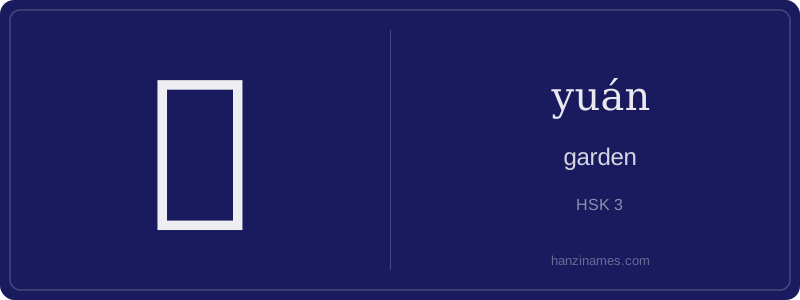
Historically, 园 appears in classical texts like the Book of Rites (Lǐjì) referring to ‘imperial gardens’ used for ancestral rites and seasonal observances. In daily life, it’s ubiquitous: ‘park’ (公园 gōngyuán), ‘kindergarten’ (幼儿园 yòu’éryuán), and ‘botanical garden’ (植物园 zhíwùyuán). A well-documented idiom is ‘桃李满天下’ (peach and plum fill the world), where ‘plum’ (李) evokes the scholar’s garden—symbolizing students nurtured by a teacher.
The character’s form is not pictographic but phono-semantic: the outer 囗 (enclosure radical) signals ‘bounded space’, while 元 (yuán) provides both sound and semantic weight—‘origin’ implying foundational, cultivated ground. No oracle bone form survives; its earliest attested use is in Warring States bamboo manuscripts as a standardized graph for managed land.
As an archaeologist sifting through layers of script evolution, I uncover 园 not as a static glyph but as a living boundary marker—its enclosing radical 囗 (wéi) a ritual perimeter drawn around cultivated life. Early inscriptions show it emerging in the Warring States period, not as a pictograph of plants, but as a conceptual container: land deliberately enclosed for human nurture. This reflects ancient China’s shift from foraging to agrarian order—where enclosure signaled ownership, care, and intentionality.
The inner component 元 (yuán), meaning 'origin' or 'first', adds temporal depth: this is not just any plot, but the foundational plot—the source of growth, the genesis of cultivation. In bronze inscriptions and bamboo slips, 园 appears alongside terms like ‘orchard’ and ‘imperial garden’, revealing its early association with elite horticulture and cosmological harmony. Its seven strokes encode a philosophy: containment + origin = cultivated potential.
Unlike wild terrain, 园 implies design, stewardship, and cyclical return—echoing Daoist and Confucian ideals of harmonious human-nature relations. Excavated Han dynasty estate records list ‘three mu of 园’ alongside grain yields, proving its administrative significance. Even today, when Chinese people write 园, they unconsciously reinscribe this millennia-old covenant: that land becomes meaningful only when tended with purpose and bounded with respect.
Example Sentences
Common Compounds
Similar Characters — Don't Mix These Up
Your First Step into Chinese Culture: Get a Chinese Name
Every journey into Chinese begins with a name. Use our free Chinese name generator to create a meaningful, personalized Chinese name that fits you perfectly.
Get My Chinese Name →