婚
Character Story & Explanation
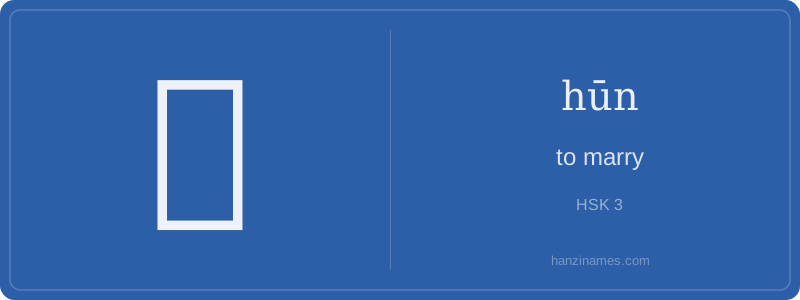
In daily life, 婚 appears ubiquitously: on marriage certificates (结婚证, jiéhūnzhèng), in news headlines about celebrity weddings, and in government policies like the Marriage Law (婚姻法). It's central to idioms such as 婚姻自由 (hūnyīn zìyóu, 'freedom of marriage'), enshrined in China’s 1950 Marriage Law — the first national law post-1949, abolishing arranged marriages and empowering women. The character also features in official statistics, e.g., 'crude marriage rate' (粗结婚率).
The written form has no verified oracle-bone precursor for 婚 itself; it first appears in seal script (c. 3rd century BCE) as a phono-semantic compound. Historically, it emerged from combining 女 and 昏 — not as a picture of dusk, but as a deliberate, literate encoding of ritual timing and gendered social function, documented in Han dynasty commentaries like the *Shuowen Jiezi* (121 CE).
As a linguistic detective, I begin with the radical: 女 (nǚ), meaning 'woman' — a clear signal this character centers on gendered social roles. The right component, 昏 (hūn), originally meant 'dusk' or 'twilight' and appears in oracle bone inscriptions as a stylized sun descending behind a hill. In ancient Chinese marriage customs, weddings were traditionally held at dusk — a time symbolizing transition and harmony between yin and yang. Thus, 婚 fuses 'woman' and 'dusk' to encode a ritual moment: the joining of two families at twilight.
The character’s structure reflects Confucian marital ideals: stability, propriety, and cosmic alignment. By the Warring States period, 婚 had standardized into its modern form, shedding earlier pictographic variants. Unlike purely phonetic characters, 婚 is a semantic-phonetic compound (形声字): 女 conveys meaning (marriage as a socially defined role for women), while 昏 provides pronunciation (hūn) and residual semantic weight (the auspicious timing). This dual-layer design reveals how Chinese writing preserves cultural memory in stroke and sound.
Modern learners often misread 昏 as merely phonetic — but its presence is intentional archaeology. Even today, the phrase 婚礼 (hūnlǐ, 'wedding ceremony') retains that twilight resonance, echoing centuries-old rites described in the *Book of Rites* (Liji). The 11-stroke construction — starting with the dot of 女, ending with the final stroke of 昏 — mirrors the ritual progression: preparation, union, completion. Every stroke is a silent witness to China’s enduring marriage ethos.
Example Sentences
Common Compounds
Similar Characters — Don't Mix These Up
Your First Step into Chinese Culture: Get a Chinese Name
Every journey into Chinese begins with a name. Use our free Chinese name generator to create a meaningful, personalized Chinese name that fits you perfectly.
Get My Chinese Name →