高
Character Story & Explanation
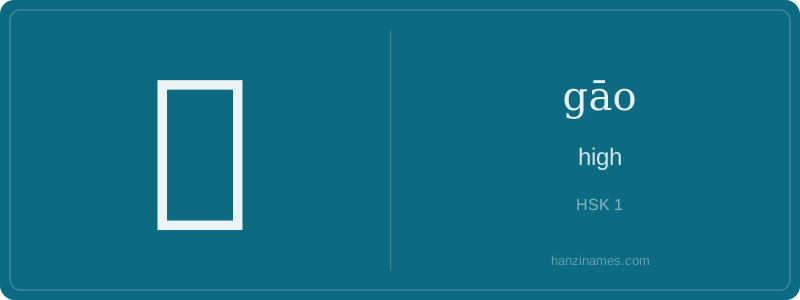
In modern China, 高 is ubiquitous in infrastructure (e.g., 高铁 gāotiě ‘high-speed rail’), education (高分 gāofēn ‘high score’), and honorifics (e.g., 高见 gāojiàn ‘insightful opinion’). A well-documented idiom is 高瞻远瞩 (gāozhānyuǎnzhǔ), meaning ‘to have foresight,’ literally ‘high-look-far-gaze,’ used since at least the Ming dynasty in military and administrative texts to praise strategic vision.
The character 高 is a pictophonetic compound first attested in bronze inscriptions (c. 11th–3rd century BCE). Its upper part (亠 + 口) resembles a raised platform or building, while the lower part (冋) historically suggested enclosure or boundary — together evoking a tall structure or elevated place. No oracle bone form survives, but Shang-Zhou bronzes confirm its early use for ‘height’ and ‘excellence.’
Imagine standing beneath the towering pagoda of the Temple of Heaven in Beijing — its layered eaves rise high above the ancient courtyard, and your neck cranes upward. That physical sensation of elevation — the visual weight of verticality, the quiet awe of something stretching toward the sky — is precisely what 高 (gāo) captures. It’s not just ‘tall’ as a measurement; it’s an embodied experience of height, prominence, and aspiration.
In Mandarin, 高 carries rich semantic layers: it describes physical altitude (a mountain), social status (a high-ranking official), abstract excellence (high standards), and even emotional intensity (high spirits). Unlike English’s context-dependent ‘high’, 高 consistently conveys a positive, elevated quality — whether you’re praising a student’s grades or admiring a skyscraper’s silhouette against the Beijing skyline.
This character appears everywhere in daily China: on metro signs indicating elevated stations (高架, gāojià), in school report cards (成绩高, chéngjī gāo), and in polite address like 高老师 (Gāo Lǎoshī) — where ‘Gāo’ may be a surname but also subtly echoes respect. Its simplicity (10 strokes, same radical as itself) belies its cultural weight: to be 高 is to be visible, valued, and aspirational — a quiet linguistic anchor of Chinese ideals of excellence and harmony with vertical space.
Example Sentences
Common Compounds
Similar Characters — Don't Mix These Up
Your First Step into Chinese Culture: Get a Chinese Name
Every journey into Chinese begins with a name. Use our free Chinese name generator to create a meaningful, personalized Chinese name that fits you perfectly.
Get My Chinese Name →