二
Character Story & Explanation
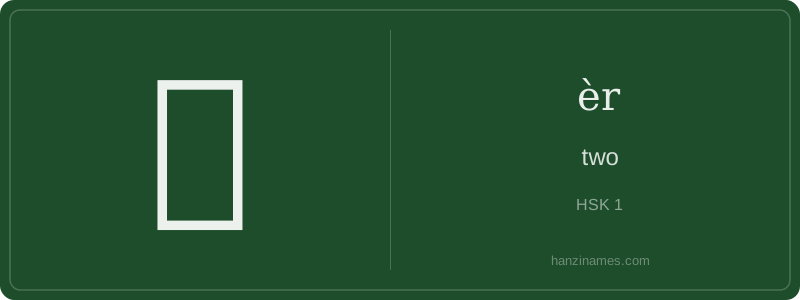
In daily life, 二 is ubiquitous: used in phone numbers, addresses (e.g., 二号楼 ‘Building No. 2’), dates (February = 二月), and as the informal, colloquial word for ‘stupid’ or ‘foolish’ (e.g., 二货 èrhuò, a common slang term documented in the 2012 Contemporary Chinese Dictionary). Historically, it appears in classical texts like the Book of Rites (Liji) specifying ‘two sacrifices’ or ‘two ranks’, always denoting precise quantity — never metaphorical abstraction.
The character’s origin is definitively non-pictographic: it is an ideograph — two parallel strokes representing the concept of duality itself. Oracle bone inscriptions confirm this from the outset; no archaeological evidence links it to depictions of eyes, birds, or paired objects. Its simplicity is intentional: pure numerical notation.
As a detective tracing the evolution of 二, I begin at the earliest confirmed inscriptions: Shang dynasty oracle bone script (c. 1200 BCE). There, 二 appears not as a pictograph of objects, but as two parallel horizontal lines — the simplest possible representation of duality. Unlike characters for 'one' (一) or 'three' (三), which also use horizontal strokes, 二 shows no variation in ancient forms; its consistency suggests it was conceived abstractly from the start, not derived from a physical object.
This minimalist design reflects early Chinese numeracy’s emphasis on ordinal clarity and visual economy. Scribes needed unmistakable symbols for counting, record-keeping, and divination tallies — where misreading ‘one’ as ‘two’ could alter ritual interpretations. The two strokes were deliberately spaced to avoid confusion with 一 (one) or 十 (ten), establishing a foundational principle: stroke count equals numeric value. No ligatures or embellishments appear in bronze inscriptions or seal script — purity of form was paramount.
By the Han dynasty, clerical script standardized the even, slightly tapered strokes we recognize today. Interestingly, 二 never developed variant forms like many other radicals — it remained unambiguously numeric across all scripts. Its stability underscores how early Chinese writing prioritized functional precision over artistic variation for core numerals. Even today, when handwritten hastily, the two strokes retain strict horizontality and separation — a testament to over 3,000 years of consistent cognitive encoding of 'twoness'.
Example Sentences
Common Compounds
Similar Characters — Don't Mix These Up
Your First Step into Chinese Culture: Get a Chinese Name
Every journey into Chinese begins with a name. Use our free Chinese name generator to create a meaningful, personalized Chinese name that fits you perfectly.
Get My Chinese Name →