起
Character Story & Explanation
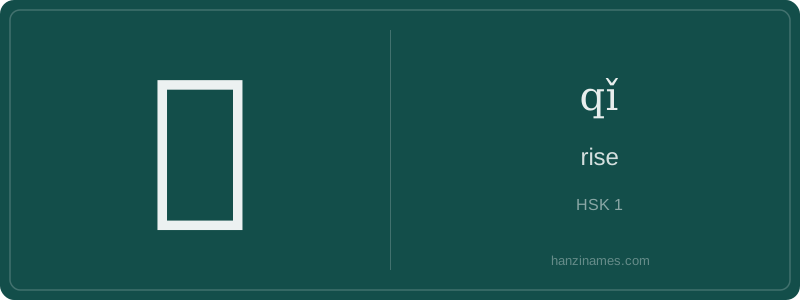
起 is indispensable in modern Mandarin: it appears in daily phrases like 起床 (qǐchuáng, 'get up'), 起风 (qǐfēng, 'wind starts blowing'), and the essential verb-complement pattern 起来 (qǐlái, 'to begin to... / to rise up'). It’s central to the HSK 1 curriculum and appears over 40 times in official HSK 1 vocabulary lists. Historically, 起 first appeared in seal script (c. 3rd century BCE) with the walking radical 走 and the phonetic element 己 — a stable form preserved into modern standard writing.
The character’s structure reflects its meaning: the left-side 走 radical (7 strokes) conveys motion, while the right-side 己 (3 strokes) primarily indicates sound (jǐ → qǐ via historical sound shift). Unlike pictographs like 日 (sun), 起 isn’t a direct picture — it’s a semantic-phonetic compound, documented consistently since the Qin dynasty bamboo slips and Han dynasty inscriptions.
Hi students! The character 起 (qǐ) is a foundational HSK Level 1 word — simple in form but rich in use. It literally means 'to rise' or 'to get up', like when you wake up and stand from bed. But it’s much more versatile: it also signals the beginning of actions ('to start'), marks origins ('from Beijing'), and appears in countless compound words. Because it’s so common, mastering 起 early helps you understand verbs, directions, and time expressions.
Notice its radical 走 (zǒu) — meaning 'to walk' or 'to move'. This tells us that 起 is about motion upward or initiation: think of lifting your body as you rise, or setting something in motion as you start a task. Even though it has only 10 strokes, its structure combines movement (走) with a phonetic component (己 jǐ), helping you both remember pronunciation and meaning.
As a beginner, focus first on its core uses: physical rising (起床 qǐchuáng — 'get up'), starting actions (开始 kāishǐ + 起 = 开始起? No — but 起 often pairs with verbs like 起来 qǐlái 'to rise up / begin to do something'), and the 'from' sense (从北京起 cóng Běijīng qǐ — 'starting from Beijing'). Don’t worry about all meanings at once — build confidence step by step!
Example Sentences
Common Compounds
Similar Characters — Don't Mix These Up
Your First Step into Chinese Culture: Get a Chinese Name
Every journey into Chinese begins with a name. Use our free Chinese name generator to create a meaningful, personalized Chinese name that fits you perfectly.
Get My Chinese Name →