小
Character Story & Explanation
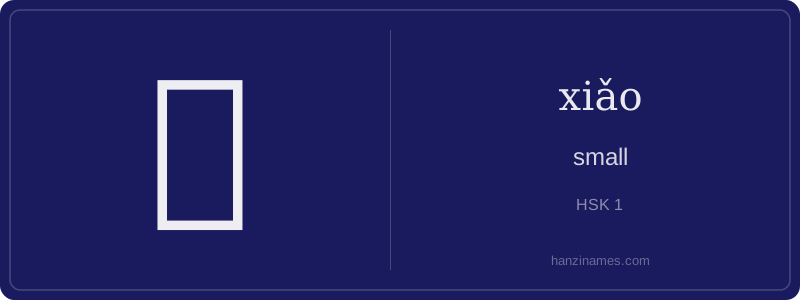
小 is ubiquitous in daily Chinese: from classroom labels (小班 'small class' for preschool), to metro station names (西小口 Xī Xiǎo Kǒu), to honorifics (小李 Xiǎo Lǐ for a young colleague). It appears in over 30 HSK-1–2 compounds and is essential in idioms like 小心翼翼 (xiǎo xīn yì yì — 'with great care', literally 'small heart, wings spread'). Historically, 小 first appeared in bronze inscriptions (c. 11th–3rd century BCE) as a simplified depiction of three dots representing scattered particles—signifying diminutiveness.
The earliest documented form (Western Zhou bronze script) shows three short, descending strokes—visually evoking tiny falling objects or grains. This pictographic origin is confirmed by paleographers like Qiu Xigui (*Chinese Writing*, 2000); no oracle bone variant survives, but bronze forms consistently use the three-dot structure to convey 'smallness' through visual sparseness—not abstraction, but concrete minimalism.
The Chinese character 小 (xiǎo) is one of the most foundational characters in Mandarin—HSK Level 1, only three strokes, and universally understood as 'small' or 'little'. Unlike English adjectives that change form for comparison (e.g., small → smaller → smallest), 小 remains unchanged grammatically but combines flexibly with other characters to express scale, age, rank, or endearment. Its simplicity belies its semantic richness: it can denote physical size, youth ('xiao pengyou' — little friend), junior status ('xiao wang' — Prince Xiao), or even humility ('xiao xin' — be careful, literally 'small heart').
In Western linguistic frameworks, 'small' is primarily a descriptive adjective tied to measurable attributes—size, quantity, or degree. But 小 carries cultural connotations rooted in Confucian values: modesty, deference, and relational hierarchy. Calling someone 小王 (Xiǎo Wáng) isn’t just about age—it signals familiarity and respectful informality, unlike English nicknames which may risk condescension. This relational nuance makes 小 more than lexical—it’s a social lubricant.
Culturally, 小 reflects East Asian aesthetics valuing subtlety and restraint—think 'small happiness' (小确幸, xiǎo què xìng), a Japanese-origin term widely adopted in Chinese internet culture to describe fleeting, quiet joys. In contrast, Western idioms like 'bigger is better' emphasize expansion and dominance. 小 thus embodies an alternative worldview: dignity in modesty, strength in restraint, and significance in the seemingly insignificant—echoing Daoist principles and Zen minimalism, where the 'small' often holds profound meaning.
Example Sentences
Common Compounds
Similar Characters — Don't Mix These Up
Your First Step into Chinese Culture: Get a Chinese Name
Every journey into Chinese begins with a name. Use our free Chinese name generator to create a meaningful, personalized Chinese name that fits you perfectly.
Get My Chinese Name →