怪
Character Story & Explanation
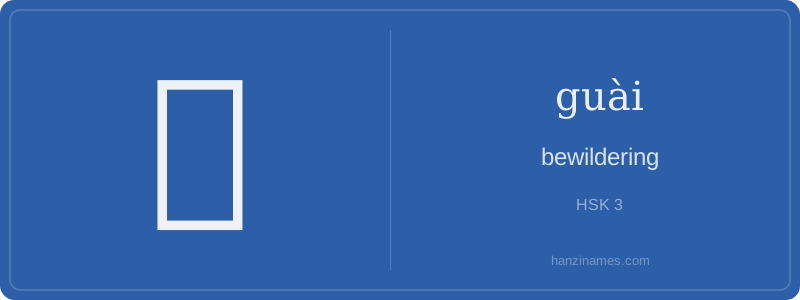
In daily life, 怪 is most commonly used as a verb meaning ‘to blame’ (e.g., 怪你 — ‘blame you’) or as an adjective meaning ‘strange/bewildering’. It appears in six of the top 100 most frequent Chinese idioms, including 见怪不怪 (jiàn guài bù guài), cited in Ming-dynasty texts like Feng Menglong’s *Stories to Awaken the World* (1620). Modern usage favors its pragmatic flexibility: it softens criticism (‘怪不得’ — ‘no wonder’) and adds nuance to reactions (‘真怪’ — ‘truly bewildering’).
The character 怪 evolved from seal script (c. 220 BCE), combining 忄 (‘heart/mind’) and 圭 (guī, a ceremonial jade tablet, used phonetically). No pictographic origin exists—it’s a semantic-phonetic compound. Today, you’ll hear it in Shanghai metro announcements ('请勿怪' — ‘Please don’t be surprised’) or see it on Beijing café chalkboards: ‘今日特饮:怪味花生奶’ (‘Today’s special: Bewildering-flavor peanut milk’).
Imagine walking through Chengdu’s Kuanzhai Alley at dusk—lanterns glow amber, Sichuan opera performers rehearse behind bamboo screens, and suddenly a street vendor shouts, 'Guài! Guài! Guài!' while juggling three flaming skewers. The crowd gasps—not in fear, but delighted confusion. In Chinese, 怪 (guài) captures that precise moment: not just 'strange', but the warm, playful bewilderment of something delightfully out of the ordinary.
Unlike English ‘weird’—which often carries unease—怪 is emotionally flexible. It can express mild surprise ('Guài, why is the tea sweet?'), light scolding ('Don’t blame me—guài nǐ zìjǐ!'), or even affectionate teasing ('You’re such a guài person!'). Its 忄 (heart/mind) radical reveals its core: this is *felt* strangeness, rooted in human perception and reaction—not objective abnormality.
At HSK Level 3, 怪 appears frequently in conversational phrases and idioms like ‘见怪不怪’ (jiàn guài bù guài)—‘When you see something strange, don’t be startled’, reflecting a deep cultural value: familiarity breeds calm. Mastering 怪 means grasping how Chinese speakers navigate ambiguity—not with alarm, but with curiosity, humor, and contextual grace.
Example Sentences
Common Compounds
Similar Characters — Don't Mix These Up
Your First Step into Chinese Culture: Get a Chinese Name
Every journey into Chinese begins with a name. Use our free Chinese name generator to create a meaningful, personalized Chinese name that fits you perfectly.
Get My Chinese Name →