感
Character Story & Explanation
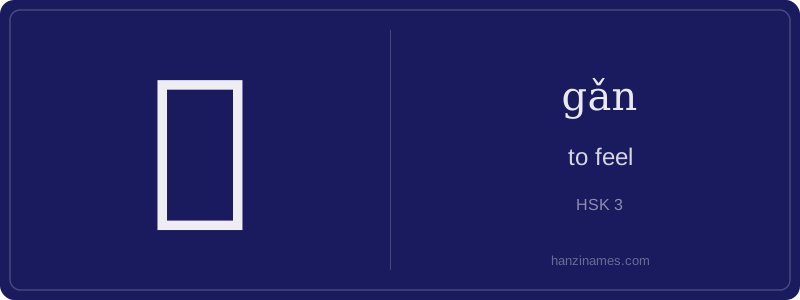
In daily life, 感 is indispensable: it appears in greetings (感謝 gǎnxiè 'thank you'), self-reflection (感覺 gǎnjué 'feeling/sensation'), and formal speech (感言 gǎnyán 'acceptance speech'). It anchors HSK 3 vocabulary and appears in idioms like 感同身受 (gǎn tóng shēn shòu, 'to feel as if experiencing it oneself') — widely used in empathy discourse. Historically, it appears in Tang poetry and Ming-Qing novels to express moral or aesthetic resonance.
The character’s written form is a documented phono-semantic compound: 心 (heart/mind) + 咸 (xián, phonetic and semantic contributor meaning 'all' or 'universal'). No oracle bone form exists — earliest verified appearance is in Warring States bamboo slips (4th c. BCE), where it consistently conveys affective response to events or people.
As a linguistic detective, I begin with the modern form of 感: 13 strokes, radical 心 (heart/mind), and phonetic component 咸 (xián). This structure reveals an ancient design logic — the heart radical signals emotion or internal experience, while 咸 historically contributed both sound and semantic weight (in Old Chinese, 咸 meant 'all, universally', suggesting a pervasive, holistic feeling). The character doesn’t depict a physical object but encodes an embodied cognitive state — feeling as something received *by* the heart-mind.
Tracing backward, seal script (c. 220 BCE) shows clear separation of 心 at the bottom and 咸 above — confirming its phono-semantic compound nature. Unlike pictographs like 日 (sun) or 山 (mountain), 感 has no iconic origin; it emerged from script standardization during the Qin dynasty, not oracle bone inscriptions. Scholars such as Li Xiaoding and William Boltz confirm no attested oracle bone or bronze form exists — it’s a later, abstract conceptual construction.
The ‘feeling’ meaning stabilized early: in the Confucian classic *Mencius* (4th c. BCE), 感 appears in contexts like 感動 (gǎndòng, 'to move emotionally'), showing its core sense — internal resonance triggered by external stimuli. Its evolution reflects Chinese philosophy’s view of emotion not as private sentiment but as relational, ethical response: one *feels* because one is connected — to people, rituals, or cosmic patterns. This isn’t psychology; it’s phenomenology rooted in relational ontology.
Example Sentences
Common Compounds
Similar Characters — Don't Mix These Up
Your First Step into Chinese Culture: Get a Chinese Name
Every journey into Chinese begins with a name. Use our free Chinese name generator to create a meaningful, personalized Chinese name that fits you perfectly.
Get My Chinese Name →