拿
Character Story & Explanation
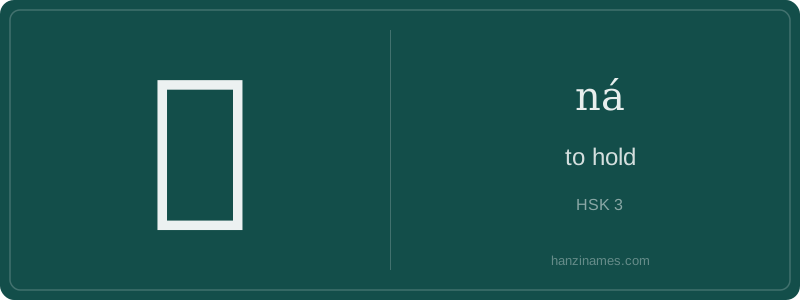
In modern Chinese, 拿 is ubiquitous in spoken and written communication—especially in imperative or transactional contexts. It appears in common phrases like ‘拿主意’ (ná zhǔyì, ‘to make a decision’) and ‘拿手好戏’ (náshǒu hǎoxì, ‘a specialty’), both documented in authoritative dictionaries like the Xiàndài Hànyǔ Cídiǎn. It’s also central to legal and administrative language (e.g., ‘拿证据’ — produce evidence). Historically, 拿 first appeared in Song dynasty vernacular texts and became standardized in Ming-Qing vernacular fiction, reflecting its roots in colloquial speech.
The character is not pictographic in origin—it evolved from the older character 接 (jiē, ‘to receive’) and was formalized during the Yuan-Ming transition. Its current form combines 手 (hand) on the left and 合 (to close/fit) on the right, symbolizing the hand closing around an object. Today, you’ll hear it constantly: a delivery rider says ‘我来拿’ (wǒ lái ná) when picking up a package—a phrase so routine, it’s printed on China’s 10 billion+ annual express labels.
Imagine bustling Beijing’s Nanluoguxiang alley at noon—vendors shout, tourists snap photos, and a young mother crouches beside her toddler. She gently ná (拿) his small hand to guide him safely across the narrow, cobblestone street. This simple act—reaching, grasping, holding—is the essence of 拿: not just physical holding, but intentional, purposeful taking or carrying. It implies agency and control, whether lifting a teacup or accepting responsibility.
In Chinese daily life, 拿 is indispensable for expressing concrete actions with implied intentionality. Unlike generic verbs like ‘have’ or ‘get’, 拿 always involves active engagement of the hands—and often the will. You don’t just ‘have’ your ID; you ná it out of your wallet before entering a bank. It’s the verb of readiness: readying keys, holding a phone, grabbing an umbrella as clouds gather. Its pragmatic weight makes it one of the most frequently used action verbs in spoken Mandarin.
HSK Level 3 learners encounter 拿 early because it unlocks countless functional phrases—from ordering food (‘ná yì bēi kāfēi’ — bring me a coffee) to giving instructions (‘ná hǎo nǐ de bāo’ — hold your bag tightly). Its radical 手 (hand) visually anchors its meaning, while its 10-stroke structure reflects balanced composition: a hand on the left, and ‘hé’ (合, to close/fit) on the right—suggesting the hand closing around something graspable. Mastery of 拿 means mastering everyday agency in Chinese.
Example Sentences
Common Compounds
Similar Characters — Don't Mix These Up
Your First Step into Chinese Culture: Get a Chinese Name
Every journey into Chinese begins with a name. Use our free Chinese name generator to create a meaningful, personalized Chinese name that fits you perfectly.
Get My Chinese Name →