放
Character Story & Explanation
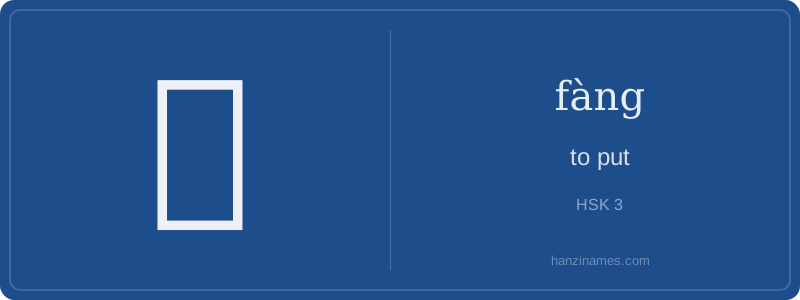
放 is ubiquitous in modern Mandarin: used in over 20 HSK-3+ compounds, including essential terms like 放学 (school dismissal), 放假 (take vacation), and 放心 (‘rest assured’). It appears in classical texts like the *Analects* (e.g., ‘君子不器’ contextually linked to ‘releasing’ rigid roles), and historically in legal codes—Tang Dynasty statutes used 放逐 (fàngzhú) for banishment. A well-documented idiom is 海阔凭鱼跃,天高任鸟放 (a variant of the famous line), where 放 underscores freedom-within-bounds.
The character evolved from seal script: left side 方 (fāng, ‘square/direction’) + right side 攵 (pū, ‘hand holding a stick’, indicating action). While not a pictograph, its structure reflects ‘directed action’—not random placement, but purposeful positioning. Today, Chinese speakers use it reflexively: e.g., teachers say ‘把作业放桌上’ (‘Put homework on the desk’) during classroom routines—a real, repeated act reinforcing spatial and social order.
‘Fàng’ (放) is a versatile, high-frequency verb meaning ‘to put’, ‘to place’, or ‘to release’. Unlike English’s static ‘put’, 放 implies intentional placement with spatial awareness—often involving movement from hand to surface (e.g., placing a book on a shelf). It’s grammatically flexible: it can take directional complements (e.g., 放下 ‘put down’), serve as a causative verb (e.g., 放人 ‘release someone’), and appear in compound verbs and idioms. Its semantic range extends metaphorically to concepts like ‘letting go’ (e.g., 放下执念 ‘release attachment’)—echoing Buddhist-influenced values of non-attachment.
In Western contexts, ‘put’ often conveys neutral, mechanical action (e.g., ‘put the key in the lock’), while 放 carries subtle intentionality and relational nuance. For instance, 放学 (fàng xué, ‘school dismissal’) doesn’t mean ‘put school’—it literally means ‘release learning’, reflecting Confucian pedagogy where learning is a cultivated process to be deliberately concluded. This contrasts with Anglo-American ‘dismissal’, which emphasizes authority rather than ritualized release.
Culturally, 放 appears in governance (e.g., 放权 fàngquán, ‘devolve power’), ecology (放生 fàngshēng, ‘release living beings’ as compassionate practice), and daily life (e.g., 放假 fàngjià, ‘grant vacation’). These usages reveal a worldview where action is not merely physical but ethically framed—‘releasing’ implies responsibility, balance, and reciprocity. Unlike Western individualist ‘letting go’, Chinese 放 often implies restoring harmony: releasing a bird, relaxing a policy, or unburdening the mind—all grounded in relational ethics rather than autonomy alone.
Example Sentences
Common Compounds
Similar Characters — Don't Mix These Up
Your First Step into Chinese Culture: Get a Chinese Name
Every journey into Chinese begins with a name. Use our free Chinese name generator to create a meaningful, personalized Chinese name that fits you perfectly.
Get My Chinese Name →