故
Character Story & Explanation
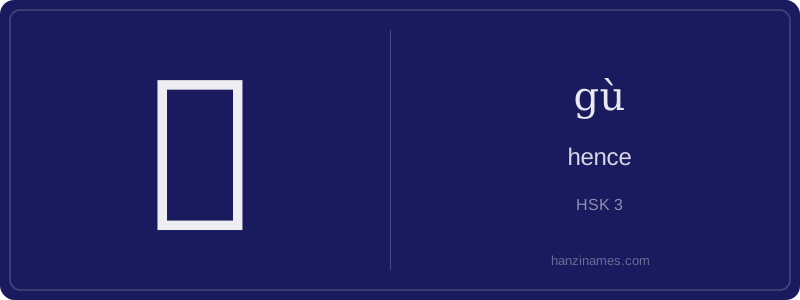
In daily life, 故 appears ubiquitously in formal and written Chinese: in logical connectors (因此, 故此), idioms (明知故犯, 无缘无故), and compound nouns (故乡, 故事). It’s indispensable in HSK 3+ writing and reading — especially in argumentative or narrative contexts. Historically, it’s documented in pre-Qin philosophical texts like the Mencius and Zuo Zhuan, consistently marking causal or temporal relationships. The phrase 何故 ('for what reason?') appears over 120 times in the Zuo Zhuan, underscoring its foundational role in classical reasoning.
The character’s form is well-documented: 古 (ancient) + 攵 (action radical). 古 itself combines 十 (ten, here symbolizing completeness) and 口 (mouth, for transmission), signifying 'that which has been spoken of for generations'. Combined with 攵, 故 thus literally means 'an action grounded in longstanding tradition or precedent' — a meaning preserved in all major uses, from 'hence' to 'homeland'.
As a detective tracing 故’s evolution, I begin at its earliest verified form in bronze inscriptions of the Western Zhou dynasty (c. 1046–771 BCE). There, it appears as a compound: 古 (gǔ, 'ancient') above and 攴 (pū, a variant of 攵, 'to strike/act') below — not a pictograph of an event, but a phonosemantic character where 古 hints at sound and antiquity, while 攴 signals agency or action. This structure already implies 'an act rooted in the past' — laying groundwork for meanings like 'reason', 'therefore', and 'former'.
By the Warring States period, 故 solidified into its modern shape with 攵 (the 'walk-strike' radical) replacing earlier 攴. The radical 攵 — composed of 丿 (a stroke suggesting motion) and 夂 (a foot-like component) — conveys deliberate, consequential action. So 故 never meant 'happening' as a neutral event; rather, it denoted *a happening with cause, consequence, or precedent*. This explains why it appears in logical connectors (hence, therefore) and nouns meaning 'reason' or 'old times' — always tethered to causality or temporal grounding.
Crucially, 故 was never used alone to mean 'happening' in classical texts — that sense is a modern pedagogical simplification. Its core semantic field is *causal antecedence*: what came before and thus explains what follows. That’s why it anchors idioms like 无缘无故 ('without reason') and phrases like 故事 ('story' — literally 'past events'). The 'happening' gloss in textbooks reflects its role in *naming* events by virtue of their origin — not describing occurrence itself. It’s less about 'what happened' and more about 'why it happened, or why it’s being recalled'.
Example Sentences
Common Compounds
Similar Characters — Don't Mix These Up
Your First Step into Chinese Culture: Get a Chinese Name
Every journey into Chinese begins with a name. Use our free Chinese name generator to create a meaningful, personalized Chinese name that fits you perfectly.
Get My Chinese Name →